The G m6/9 Chord Explained
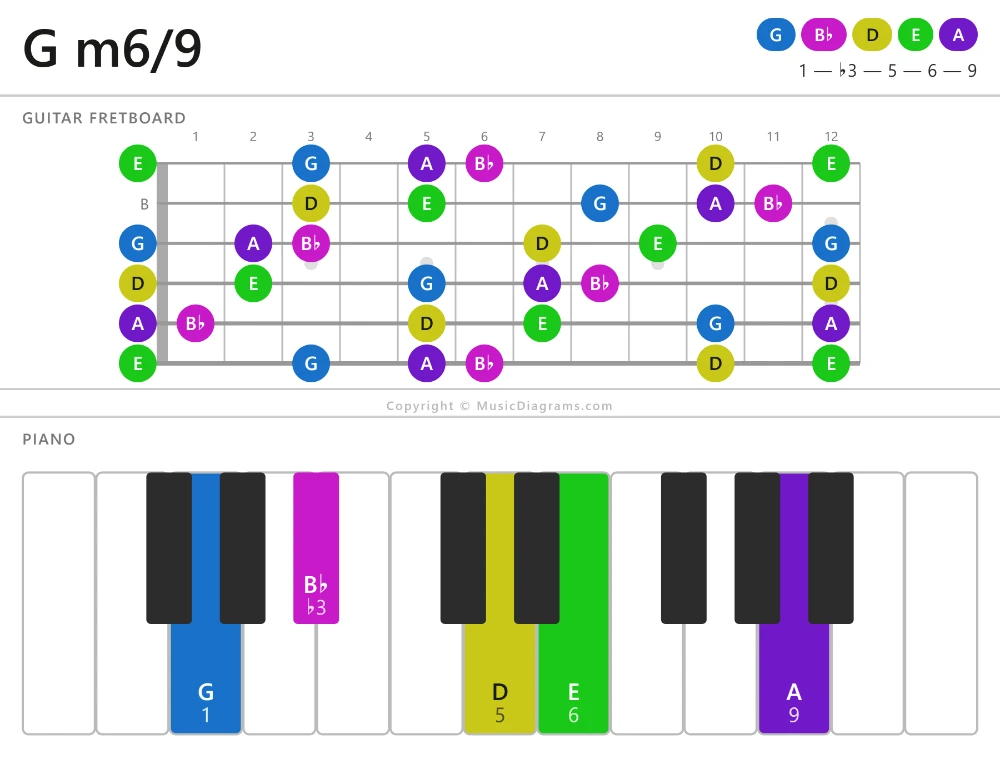
G minor sixth add ninth is a Minor chord family color chord built from the notes G, B♭, D, E, and A. Its root is G, and its interval number formula is 1-♭3-5-6-9, which gives you the interval names root, minor third, perfect fifth, major sixth, and major ninth. You may also see it written as Gm6/9, Gmin6/9, or G minor 6/9. If you look at the widget above, you can use the piano and guitar diagrams to spot these notes clearly and hear how they combine into one richer minor sound. To learn more about how these note distances work, see understanding chord intervals.
G m6/9 Alternate Names
- Gm6/9
- Gmin6/9
- G minor 6/9
G m6/9 Chord Notes
G m6/9 Chord Formula
G m6/9 Chord Notation
How To Use G m6/9 In Music
Because this chord is minor but also includes the warm 6th and airy 9th, it often sounds gentle, jazzy, reflective, and slightly sophisticated rather than dark or heavy. It can work well as a tonic minor color chord, a passing harmony, or a softer alternative to a plain minor triad in styles like jazz, soul, pop, and film music. For example, in G minor you might hear i–iv–V as Gm6/9–Cm–D, or in a smoother loop like i–♭VII–iv–V as Gm6/9–F–Cm–D. The chords around it greatly affect its mood: next to tense chords it can feel tender and calm, while next to brighter major chords it can sound wistful and expressive. If you are new to chord basics, this is still a type of minor chord, just with added color tones.
G m6/9 Chord Inversions
Another useful idea is inversion, which means playing the same chord with a note other than G in the bass. For Gm6/9, examples include first inversion with B♭ in the bass, second inversion with D in the bass, and other smooth bass placements such as E or A in the bass. Even though the notes stay the same, the sound can change quite a bit: G in the bass feels most settled, B♭ can sound softer, D can sound more open, and E or A in the bass can make the chord feel more floating or modern. Musicians use inversions to create smoother bass lines, connect chords with less movement, and shape the mood of a progression without changing the chord’s basic identity.