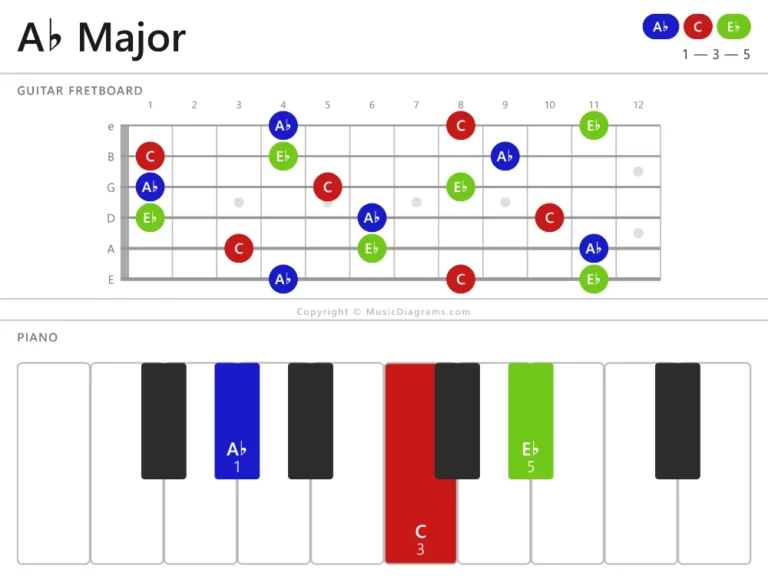
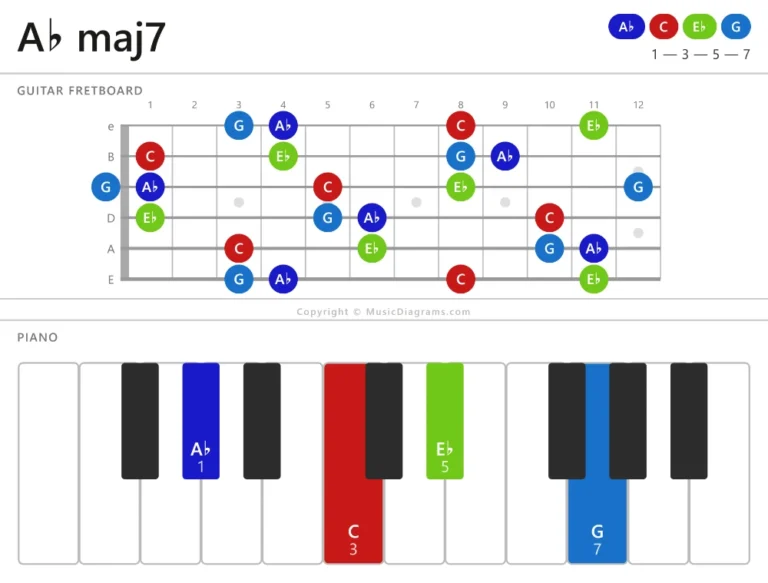
The A♭ 6 Chord Explained
A-flat sixth is a Major chord family chord built from the notes A♭, C, E♭, and F. Its root is A♭, and its interval number formula is 1–3–5–6, which gives you the interval names root, major third, perfect fifth, and major sixth. You may also see it written as A♭6, A-flat 6, or A-flat major sixth. If you look at the widget above, you can use the piano and guitar diagrams to see how these four notes stack together, and the chord tones can help you hear how the sound is formed from the root upward.
A♭ 6 Alternate Names
- A♭6
- A-flat 6
- A-flat major sixth
A♭ 6 Chord Notes
A♭ 6 Chord Formula
A♭ 6 Chord Notation
How To Use A♭ 6 In Music
Often, A♭6 sounds warm, settled, and sweet, with a softer color than a plain major chord because the added sixth gives it extra richness without making it feel very tense. It can work well as a home chord or as a colorful change in styles like pop, jazz, soul, and older ballads. For example, in A♭ major you might hear I–vi–ii–V as A♭6–Fm–B♭m–E♭, or use I–IV–V–I as D♭–E♭–A♭6. The mood of the chord can feel more relaxed next to minor chords, or brighter when it resolves after stronger tension from a dominant chord. To better understand why these note combinations create that effect, it helps to study chord intervals.
A♭ 6 Chord Inversions
Because A♭6 has four notes, it can appear in several inversions, which means a note other than A♭ is placed at the bottom. In root position, A♭ is the lowest note, but the chord can also be played in first inversion with C in the bass, second inversion with E♭ in the bass, or third inversion with F in the bass. These inversions do not change the basic chord quality, but they do change the weight and flow of the sound. A bass note of C can feel smoother and lighter, E♭ can feel stable and open, and F in the bass can sound especially gentle or jazzy. Musicians use inversions to connect chords more smoothly, avoid big jumps, and shape the mood of a progression with a more polished sound.