The A♭ 7 Chord Explained
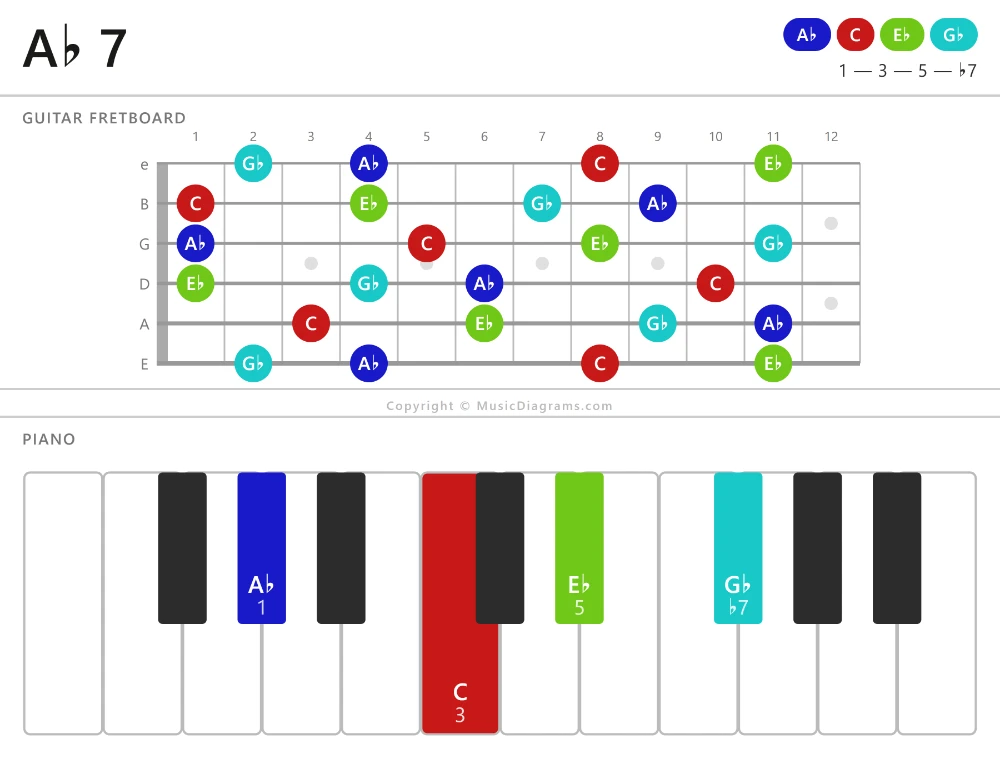
A-flat dominant seventh is a Dominant chord family chord built from the notes A-flat, C, E-flat, and G-flat. Its root is A-flat, and its interval number formula is 1–3–5–♭7, which gives you the interval names root, major third, perfect fifth, and minor seventh. You may also see it written as A-flat 7, Ab7, or A-flat dominant 7th. If you look at the widget above, you can see and hear how these four notes combine to create this chord, and learning more about the chord root can make the shape easier to understand.
A♭ 7 Alternate Names
- Ab7
- A-flat 7
- A-flat dominant 7th
A♭ 7 Chord Notes
A♭ 7 Chord Formula
A♭ 7 Chord Notation
How To Use A♭ 7 In Music
Because a dominant seventh chord has both brightness from the major triad and tension from the lowered seventh, A-flat 7 often sounds strong, bluesy, restless, and ready to move. It commonly pulls toward D-flat major, so in that key it works as V, such as I–IV–V–I with D-flat–G-flat–A-flat 7–D-flat. You might also hear it in blues progressions like I7–IV7–V7, where A-flat 7 acts as I7 in A-flat blues. The chords around it can make it feel warmer, sharper, smoother, or more dramatic, especially depending on how strongly it resolves. If you want to understand why that pull feels so natural, this guide to a dominant chord is helpful.
A♭ 7 Chord Inversions
Another useful idea is inversion, which means the chord keeps the same notes but starts from a note other than the root. For A-flat 7 in root position, the notes are A-flat–C–E-flat–G-flat, while its inversions are C–E-flat–G-flat–A-flat (1st inversion), E-flat–G-flat–A-flat–C (2nd inversion), and G-flat–A-flat–C–E-flat (3rd inversion). Inversions can make the chord sound smoother or less heavy because the bass note changes, and they are often used to connect chords with less jumping between notes. Players may choose an inversion to create a gentler bass line, a tighter accompaniment, or a stronger feeling of motion into the next chord.