The G♭ 7 Chord Explained
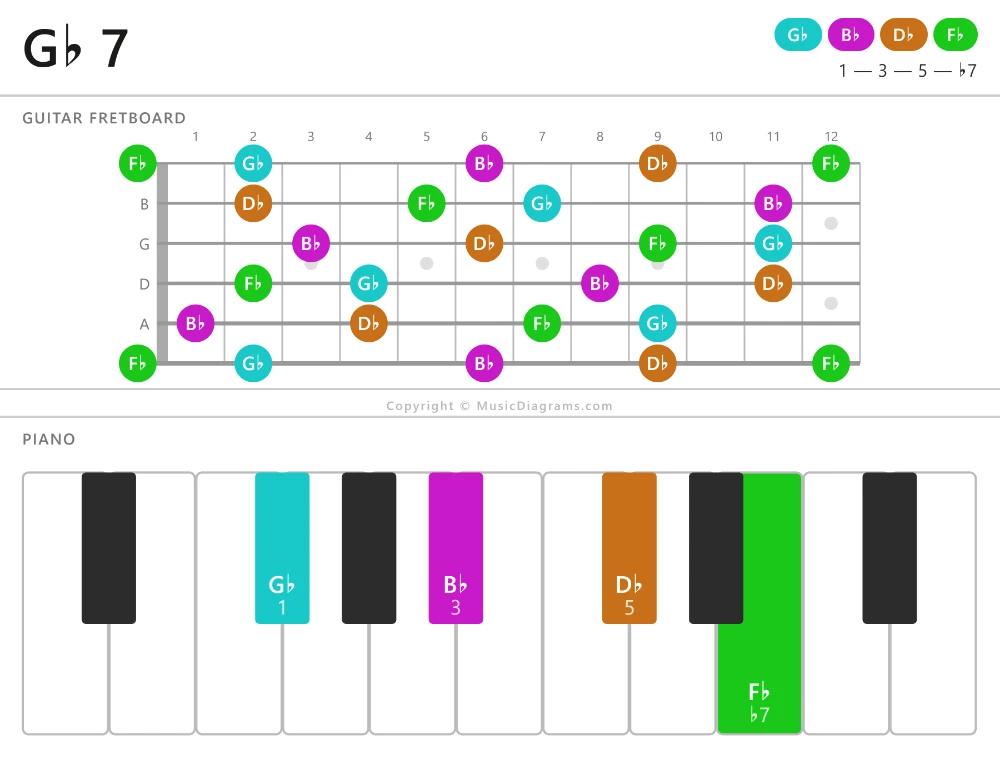
G-flat dominant seventh is a Dominant chord built from the notes G-flat, B-flat, D-flat, and F-flat. Its root is G-flat, and its interval number formula is 1–3–5–♭7, which gives you the interval names root, major third, perfect fifth, and minor seventh. You may also see it written as G-flat 7, G-flat dominant 7, or Gb7. If you are new to chords, the widget above can help you see and hear these notes together, and it may also help to learn more about the chord root and how it anchors the sound.
G♭ 7 Alternate Names
- Gb7
- G-flat dominant 7
- G-flat dominant seventh
G♭ 7 Chord Notes
G♭ 7 Chord Formula
G♭ 7 Chord Notation
How To Use G♭ 7 In Music
Often, this chord sounds strong, bluesy, and a little tense, which is exactly why it is so useful in music. A dominant seventh chord naturally wants to move somewhere, so G-flat 7 often appears before a chord that feels more settled. For example, in the key of C-flat major, V7–I would be G-flat 7 moving to C-flat major, and in a longer progression you might hear ii–V7–I or I–IV–V7–I. The chords around it can make it feel brighter, jazzier, more dramatic, or more relaxed, so context matters a lot. If you want a beginner-friendly explanation of why this chord creates pull and release, see this guide to dominant chords.
G♭ 7 Chord Inversions
Another useful idea is inversion, which means keeping the same chord tones but putting a note other than the root in the bass. For G-flat 7, root position is G-flat–B-flat–D-flat–F-flat, first inversion is B-flat–D-flat–F-flat–G-flat, second inversion is D-flat–F-flat–G-flat–B-flat, and third inversion is F-flat–G-flat–B-flat–D-flat. These inversions do not change the chord’s name family, but they do change the weight and color of the sound. Root position usually feels the most stable and direct, while inversions can sound smoother, softer, or more connected to the next chord. Players use them to create better voice leading, make bass lines flow more naturally, and shape the mood of a progression without changing the basic harmony.