The F♭ maj7 Chord Explained
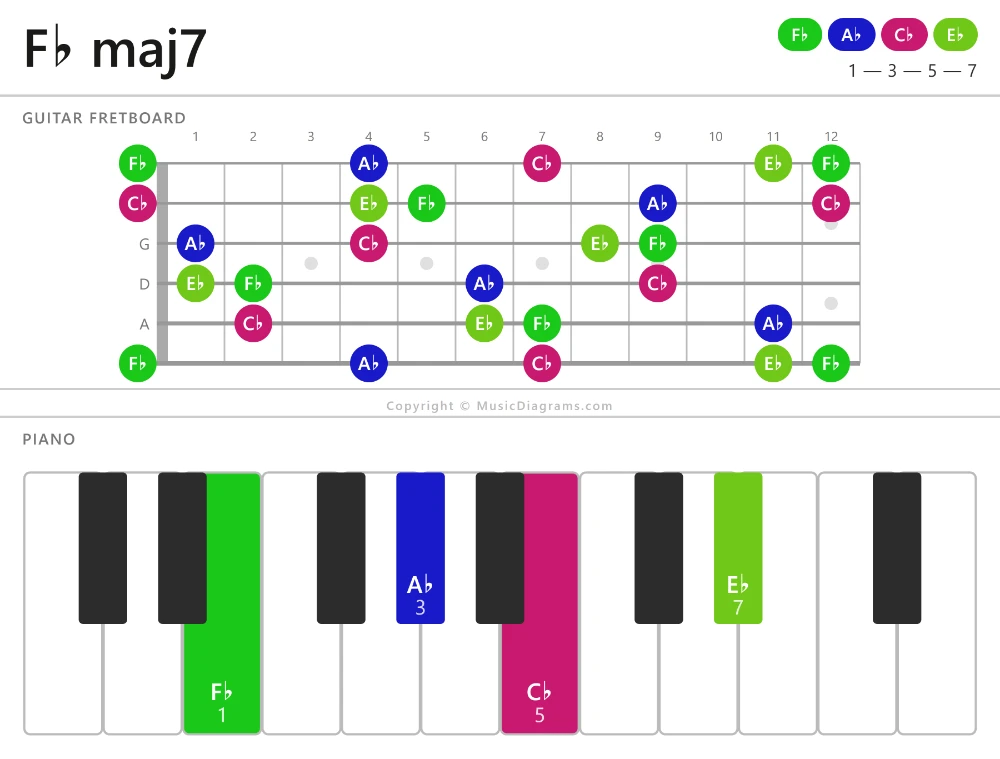
F-flat major seventh is a Major chord family chord built from the notes F-flat, A-flat, C-flat, and E-flat. Its root is F-flat, and its interval formula is 1–3–5–7, which gives you the interval names root, major third, perfect fifth, and major seventh. You may also see it written as F-flat maj7, F-flat Δ7, or F-flat major 7. If you look at the widget above, you can match these notes on the piano and guitar diagrams and hear how the chord tones combine; this is also a great way to begin understanding chord intervals as a beginner.
F♭ maj7 Alternate Names
- F-flat maj7
- F-flat major 7
- F-flat Δ7
F♭ maj7 Chord Notes
F♭ maj7 Chord Formula
F♭ maj7 Chord Notation
How To Use F♭ maj7 In Music
Because of its major seventh, this chord sounds smooth, warm, and slightly dreamy rather than fully bright or plain. F-flat major seventh can be used to create a calm, lush, or reflective mood in pop, jazz, soul, film music, and softer ballads. Its feeling can change depending on the chords around it: on its own it feels settled, but next to tenser chords it can sound more emotional or sophisticated. For example, in a major-key progression it might appear as I–vi–ii–V when F-flat major seventh is the I chord, or in a smoother color-rich pattern such as I–IV–ii–V. When learning how it behaves next to other harmony, it can help to compare it with a basic major chord, since the added seventh is what gives this chord its extra color.
F♭ maj7 Chord Inversions
Another useful idea is inversion, which means the notes stay the same but a note other than the root is placed in the bass. For F-flat major seventh, root position is F-flat–A-flat–C-flat–E-flat, first inversion is A-flat–C-flat–E-flat–F-flat, second inversion is C-flat–E-flat–F-flat–A-flat, and third inversion is E-flat–F-flat–A-flat–C-flat. Inversions do not change the chord’s identity, but they do change its weight and flow: first inversion often sounds lighter, second inversion can feel more open, and third inversion can sound especially delicate or unresolved because the seventh is in the bass. Players use inversions to make chord changes smoother, create stepwise bass lines, and shape the mood without changing the harmony itself.