The E♯ mMaj9 Chord Explained
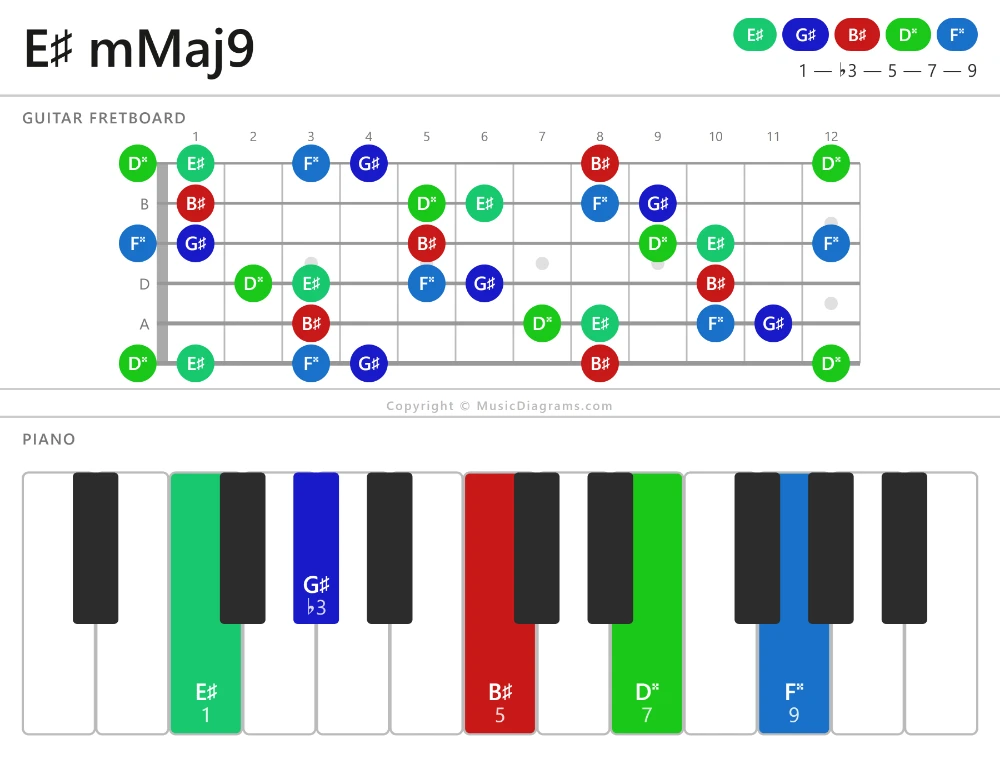
E-sharp minor major ninth is a Minor chord family sonority with a rich, tense color built from the notes E♯, G♯, B♯, D♯♯, and F♯♯. Its root is E♯, and its interval number formula is 1–♭3–5–7–9, which gives you the interval names root, minor third, perfect fifth, major seventh, and major ninth. You may also see it written as E♯mMaj9, E♯min(maj9), or E♯-maj9. If you look at the widget above, you can match these chord tones on the piano and guitar diagrams to help picture how the chord is built, and learning more about chord intervals can make this structure much easier to understand.
E♯ mMaj9 Alternate Names
- E♯mMaj9
- E♯min(maj9)
- E♯-maj9
E♯ mMaj9 Chord Notes
E♯ mMaj9 Chord Formula
E♯ mMaj9 Chord Notation
How To Use E♯ mMaj9 In Music
Because of its minor quality paired with a bright major seventh and ninth, this chord sounds emotional, sophisticated, and slightly mysterious. It can feel dramatic in jazz, film music, and more modern harmonic settings, often working as a color chord rather than a simple stable resting point. Its mood can shift depending on the chords around it: after a darker minor chord it may sound more haunting, while before a resolution it can feel beautifully tense. For example, in a minor-key style progression you might hear i–iv–i(maj9), or a more extended motion such as iv–V–i(maj9). If E♯ minor major ninth is treated as the tonic, that makes it i; in another context, the same notes might be heard differently depending on the harmonic setting. To compare its basic color with a simpler related harmony, you can also read about what is a minor chord.
E♯ mMaj9 Chord Inversions
Inversions happen when a note other than the root is placed in the bass, which changes the weight and flow of the chord without changing its essential note collection. For E♯mMaj9, root position has E♯ in the bass, while inversions could place G♯, B♯, D♯♯, or F♯♯ underneath. A first inversion, with G♯ in the bass, can sound softer and less grounded; an inversion with the major seventh or ninth in the bass can sound especially floating or tense. Players and composers use inversions to create smoother bass lines, connect chords more naturally, and shape the mood of a progression with more subtlety. Variations related to this sound may include simpler forms such as E♯mMaj7 or a more open voicing that spreads the same notes farther apart, giving the chord a more spacious character.