The E♭ sus2 Chord Explained
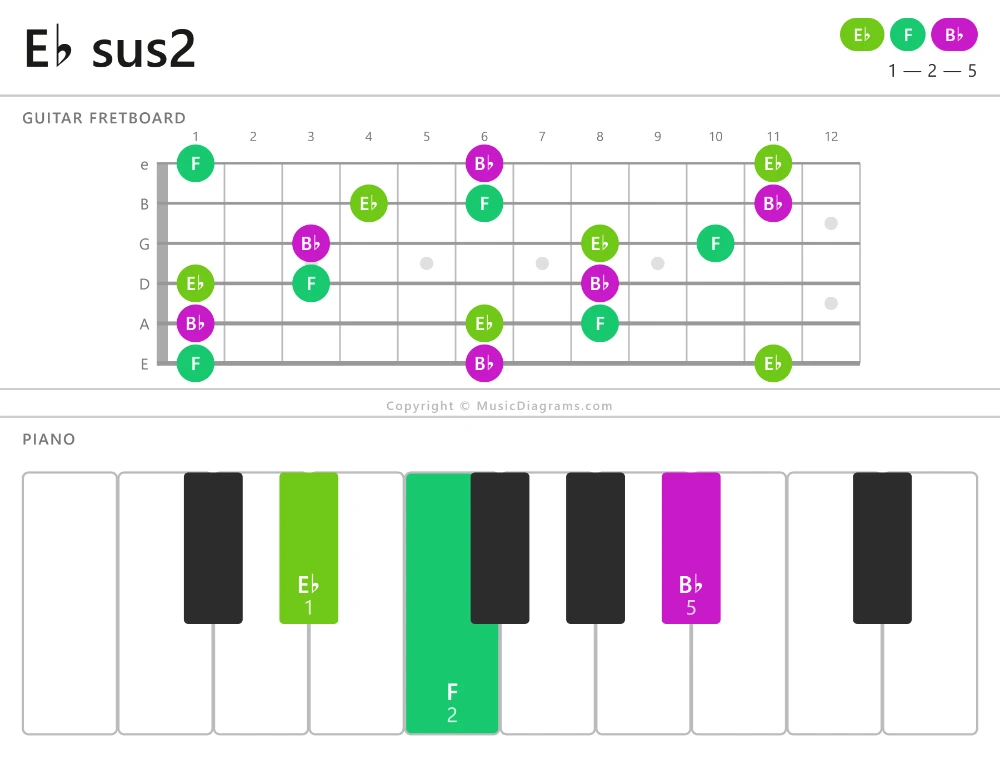
E-flat suspended second is a Suspended chord built from the notes E-flat, F, and B-flat. Its root is E-flat, and its interval number formula is 1-2-5, which gives you the interval names root, major second, and perfect fifth. Because the third is left out and replaced by the second, this chord has an open, unresolved sound that is different from a major or minor chord. You may also see it written as E-flat sus2, E♭sus2, or E-flat suspended 2nd. If you want to understand how these note distances work, this guide to chord intervals can help, and the widget above lets you see and hear the root-position chord clearly.

"1-4-5 That's Sus" T-Shirt
Only True Musicians Get This. For musicians in the know. This funny 1-4-5 suspended chord pun shirt is the perfect gift for guitarists, pianists, music teachers, and music nerds.
E♭ sus2 Alternate Names
- E-flat sus2
- E♭sus2
- E-flat suspended 2nd
E♭ sus2 Chord Notes
E♭ sus2 Chord Formula
E♭ sus2 Chord Notation
How To Use E♭ sus2 In Music
Often, E-flat suspended second sounds airy, gentle, and slightly expectant, as if it is waiting to move somewhere else. That makes it useful in pop, rock, worship, film music, and acoustic songwriting when you want a soft tension without the sharper pull of a dissonant chord. Its mood can feel calm when surrounded by stable chords, or more dramatic when it delays a resolution into E-flat major or E-flat minor. For example, in the key of B-flat major, E-flat sus2 can act like IV in a progression such as I-IV-V-I, and in the key of E-flat major it may appear as I in I-V-vi-IV. Since suspended chords are neither clearly major nor minor, the chords around them strongly shape how listeners hear their color and direction.
E♭ sus2 Chord Inversions
Another helpful idea for beginners is inversion, which means playing the same chord with a note other than the root at the bottom. For E-flat suspended second, root position is E-flat-F-B-flat, first inversion is F-B-flat-E-flat, and second inversion is B-flat-E-flat-F. These inversions keep the same three notes but can change the weight and smoothness of the sound. A first inversion can feel a little lighter or less settled, while a second inversion can sound more spacious or create a stronger sense of movement into the next chord. Players use inversions to make chord changes smoother, support a melody note, or create a different bass line. If you want to learn more about why E-flat is the starting note of this chord, see how a chord root works.