The D♭ 7♭5 Chord Explained
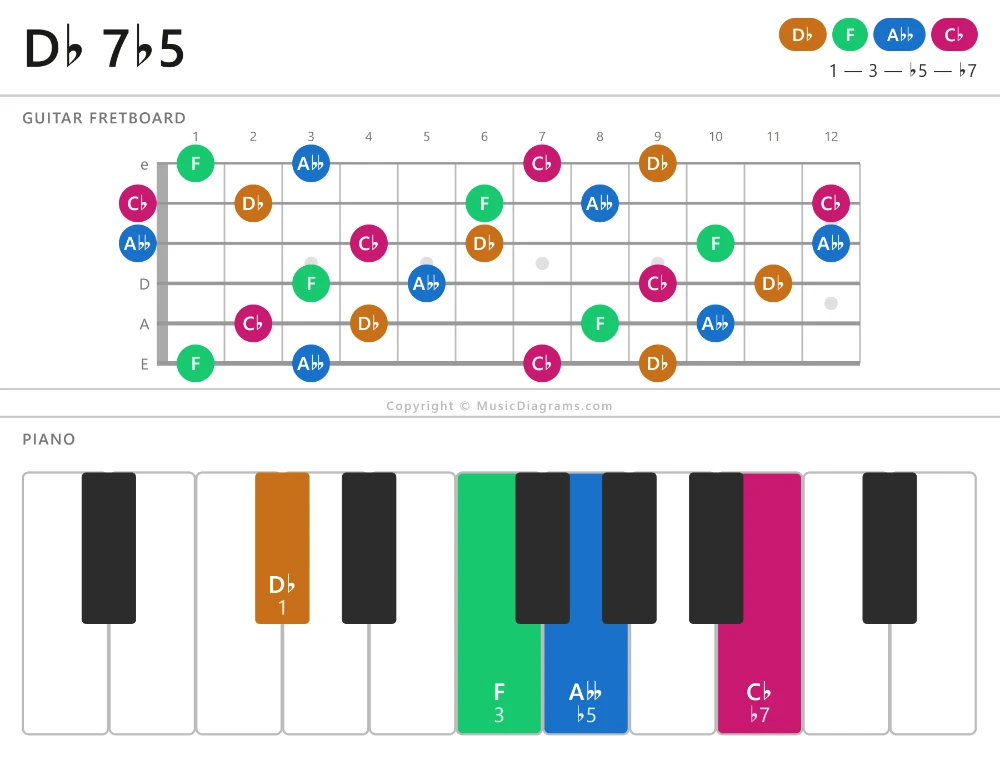
D-flat seven flat five is a Dominant chord built from the notes D-flat, F, A-double-flat, and C-flat. Its root is D-flat, and its interval number formula is 1–3–♭5–♭7. In interval names, that gives you the root, major third, diminished fifth, and minor seventh. You can use the chord widget above to see and hear these chord tones clearly, which is especially helpful because the flat-five color makes this chord sound more unusual than a regular dominant seventh. This chord may also be written as D♭7♭5, D-flat dominant seventh flat five, or D-flat seven flat five.
D♭ 7♭5 Alternate Names
- D♭7♭5
- D-flat dominant seventh flat five
- D-flat seven flat five
D♭ 7♭5 Chord Notes
D♭ 7♭5 Chord Formula
D♭ 7♭5 Chord Notation
How To Use D♭ 7♭5 In Music
Because of its lowered fifth, this chord sounds tense, unstable, and slightly mysterious, with more bite than a normal dominant seventh chord. It often pushes strongly toward resolution, so you might hear it leading to a chord a fifth below, or used as a colorful passing dominant in jazz, blues, film, or theatrical harmony. For example, in G-flat major, D♭7♭5 can function as V7♭5 moving to I, as in ii–V7♭5–I. In more chromatic progressions, it might appear in something like I–#I°–ii–V7♭5 before resolving. The mood can feel harsher or more dramatic depending on the surrounding harmony, and learning about chord intervals can make that tension easier to understand.
D♭ 7♭5 Chord Inversions
Another useful idea for beginners is inversion, which means keeping the same four notes but placing a note other than D-flat in the bass. With F in the bass, you have first inversion; with A-double-flat in the bass, second inversion; and with C-flat in the bass, third inversion. These inversions do not change the chord’s identity, but they do change its weight, balance, and smoothness. A root-position D-flat seven flat five often sounds strongest and most direct, while inversions can sound softer, more flowing, or more suspenseful depending on what comes before and after. Musicians use inversions to create smoother bass lines, connect chords with less jumping, and shape the mood of a progression more naturally.