The C♭ maj7 Chord Explained
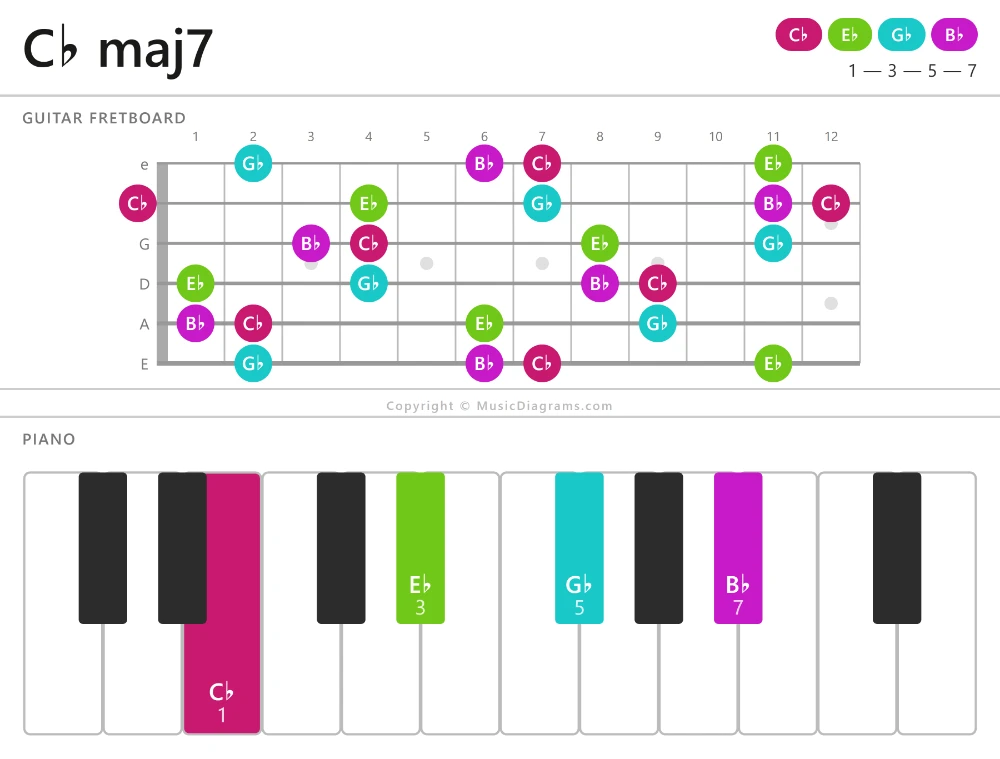
C-flat major seventh is a Major chord family sonority built from the notes C-flat, E-flat, G-flat, and B-flat. Its root is C-flat, and its interval number formula is 1–3–5–7, which gives you the interval names root, major third, perfect fifth, and major seventh. You may also see it written as C-flat maj7, C-flat major 7, or C-flat Δ7. If you look at the widget above, you can use it to spot these chord tones on piano and guitar and hear how they combine; this is also a great way to start understanding chord intervals as a beginner.
C♭ maj7 Alternate Names
- C-flat maj7
- C-flat major 7
- C-flat Δ7
C♭ maj7 Chord Notes
C♭ maj7 Chord Formula
C♭ maj7 Chord Notation
How To Use C♭ maj7 In Music
Because of its major seventh, this chord sounds smooth, rich, warm, and a little dreamy rather than plain or fully settled. It often appears in jazz, pop, soul, film music, and softer singer-songwriter styles when a composer wants a colorful major sound. In a key where C-flat functions as the tonic, you might hear I–vi–ii–V with C-flat maj7 as the I, or a gentler loop such as I–V–vi–IV centered around C-flat maj7. The mood can shift depending on the surrounding harmony: next to brighter major chords it can feel lush and elegant, while beside tenser chords it can sound more reflective. If you want to compare its basic major quality with a simpler sonority, see what is a major chord.
C♭ maj7 Chord Inversions
Another useful idea for beginners is inversion, which means the chord keeps the same notes but starts from a different note in the bass. For C-flat major seventh in root position, C-flat is the lowest note; in first inversion, E-flat is lowest; in second inversion, G-flat is lowest; and in third inversion, B-flat is lowest. These inversions do not change the chord’s name family, but they do change its weight and color. A root-position voicing feels the most stable, while inversions can sound lighter, smoother, or more flowing, especially when moving from one chord to the next. Musicians use inversions to create better bass lines, reduce big jumps between chords, and give a progression a more polished sound.