The B♯ maj9 Chord Explained
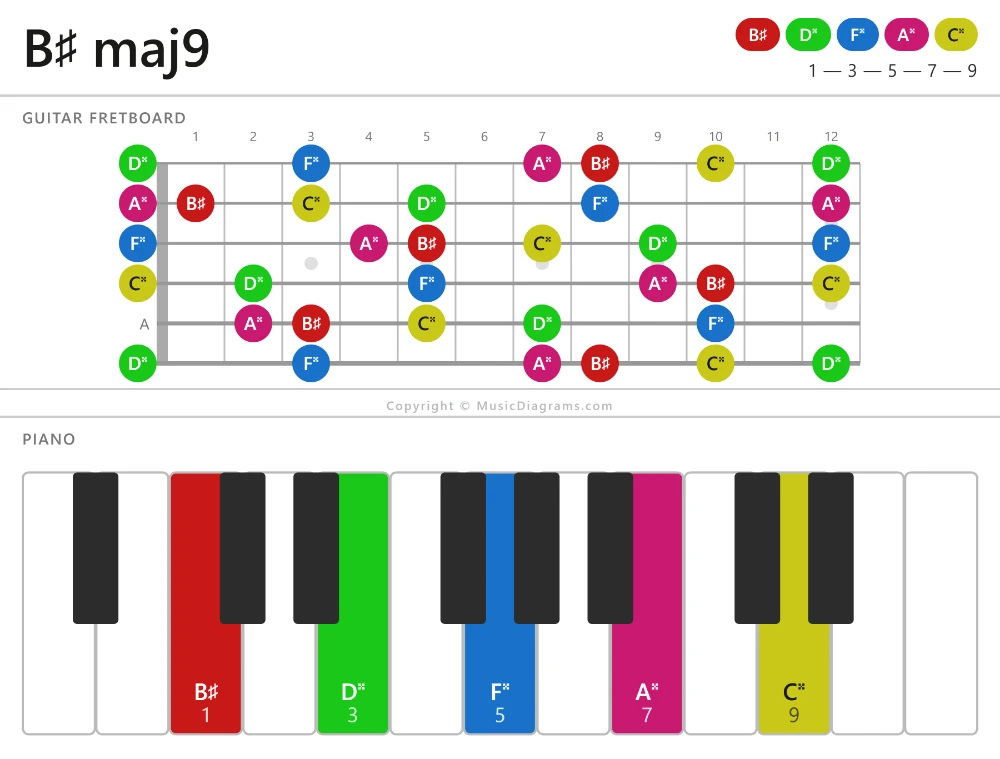
B-sharp major ninth is a Major chord family color chord built from the notes B♯, D♯♯, F♯♯, A♯♯, and C♯♯. Its root is B♯, and its interval number formula is 1–3–5–7–9. That means the chord contains a root, major third, perfect fifth, major seventh, and major ninth. You may also see it written as B♯maj9, B♯M9, or B♯Δ9, all meaning the same basic sound. If you look at the widget above, you can match these chord tones on piano or guitar and hear how the stacked intervals create a rich, polished sound; if you are new to this idea, this guide to chord intervals can help.
B♯ maj9 Alternate Names
- B♯maj9
- B♯M9
- B♯Δ9
B♯ maj9 Chord Notes
B♯ maj9 Chord Formula
B♯ maj9 Chord Notation
How To Use B♯ maj9 In Music
Because of its major seventh and ninth, this chord sounds bright, smooth, elegant, and slightly dreamy rather than plain or simple. It often appears in jazz, pop, film music, and softer contemporary styles when a songwriter wants more color than a basic major chord. In a progression, B♯maj9 can feel restful as a home chord, or it can sound more tense or surprising depending on the harmony around it. For example, in a major-key style progression like ii–V–I, this chord could function as the final I chord; in a gentler loop such as vi–IV–I–V, it can add warmth and shine to the tonic area. When placed after darker chords, it may sound especially luminous, while next to other lush chords it blends into a silky texture. If you want a clearer foundation first, it also helps to understand what is a major chord.
B♯ maj9 Chord Inversions
Another useful idea is inversion, which means playing the same chord with a note other than the root at the bottom. For B♯ major ninth, root position has B♯ as the lowest note, while inversions could place D♯♯, F♯♯, A♯♯, or C♯♯ in the bass. These inversions do not change the chord’s name family, but they do change its weight, smoothness, and direction. A third in the bass can sound softer and more flowing, a fifth in the bass can feel stable but less final, and upper chord tones in the bass can create a more floating or modern color. Players use inversions to connect chords smoothly, reduce big jumps between shapes, and shape the emotional pull of a progression.