The B Major Chord Explained
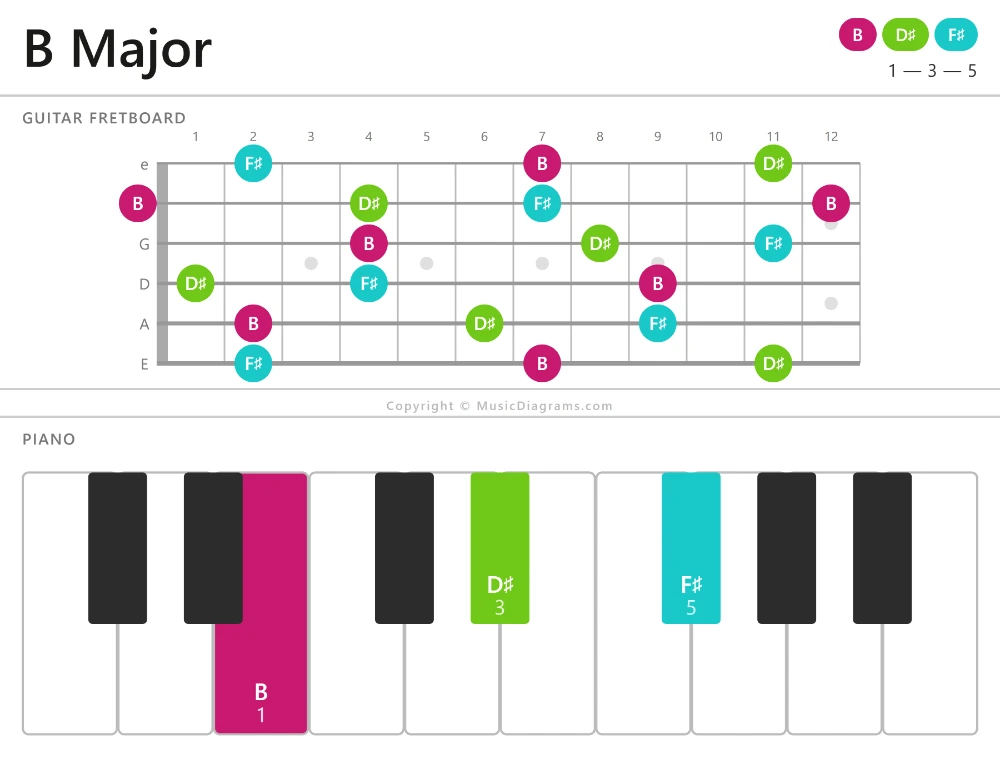
B major is a Major chord built from the notes B, D♯, and F♯. Its root is B, and its interval number formula is 1–3–5, which gives you the interval names root, major third, and perfect fifth. This is one of the most important chord shapes in music because it sounds stable, bright, and complete. If you look at the widget above, you can see and hear these three chord tones clearly, which is a great way to connect the shape of the chord with its sound. You may also see this chord written as B major chord, B, or Bmaj. If you are new to chord construction, understanding chord intervals can make this formula much easier to recognize.
B Major Alternate Names
- B major chord
- B
- Bmaj
B Major Chord Notes
B Major Chord Formula
B Major Chord Notation
How To Use B Major In Music
Because of its strong and settled sound, B major often creates a feeling of confidence, warmth, or resolution. It works especially well as a home chord in the key of B major, but its mood can shift depending on the chords around it. For example, moving from E to B feels resolved and satisfying, while going from F♯ to B sounds even more final because that is a classic V–I motion. In Roman numerals, B major can appear as I in I–IV–V, as IV in F♯ major, or as V in E major. In a progression like I–vi–IV–V, the chord can sound uplifting, but in a slower setting with minor chords nearby, it may feel more reflective. To understand why this chord feels so balanced, it also helps to learn what a major chord is.
B Major Chord Inversions
Another useful idea for beginners is inversion, which means the chord keeps the same notes but starts on a different one. In root position, B major is B–D♯–F♯. Its first inversion is D♯–F♯–B, and its second inversion is F♯–B–D♯. These inversions still sound like B major, but they change the bass note, which can make the chord feel smoother, lighter, or less final. Musicians use inversions to connect chords more smoothly, avoid large jumps, and create a different sense of movement in a progression. For example, using B major in first inversion between other chords can make the bass line flow more naturally, while second inversion can add a slightly more open and transitional sound.