The B♭ 11 Chord Explained
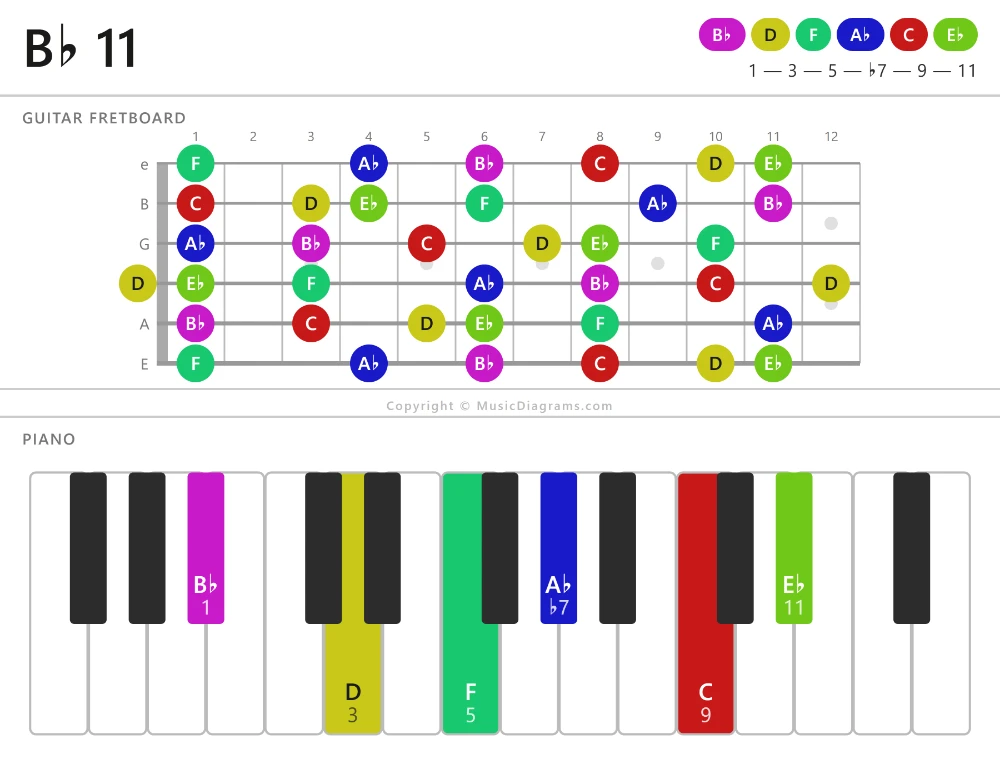
B-flat eleven is a Dominant chord family member built from the notes B♭, D, F, A♭, C, and E♭. Its root is B♭, and its interval number formula is 1–3–5–♭7–9–11. In interval names, that gives you the root, major third, perfect fifth, minor seventh, major ninth, and perfect eleventh. You may also see it written as B♭11, Bb11, or B-flat dominant eleven. If you look at the widget above, you can use it to see and hear how these notes combine, and if you want to learn more about how these distances are built, see chord intervals.
B♭ 11 Alternate Names
- B♭11
- Bb11
- B-flat dominant eleven
B♭ 11 Chord Notes
B♭ 11 Chord Formula
B♭ 11 Chord Notation
How To Use B♭ 11 In Music
Because it includes both the strong pull of a dominant seventh chord and the added color of the 9th and 11th, B♭11 sounds rich, bluesy, open, and slightly tense. It can create motion that wants to resolve, but it can also sit as a colorful groove chord in funk, jazz, soul, and gospel. The chords around it greatly affect its mood: moving from E♭maj7 to B♭11 to F7 can feel warm and spacious, while using B♭11 as V in a progression like V–I gives it a stronger sense of direction. In E♭ major, for example, B♭11 works as V leading to E♭, and in longer progressions you might hear it in patterns such as ii–V–I or I–IV–V. Since this chord belongs to the dominant sound world, you may also enjoy reading about what makes a dominant chord.
B♭ 11 Chord Inversions
Inversions happen when a note other than the root is placed at the bottom of the chord. For B♭11, root position has B♭ as the lowest note, but an inversion might put D, F, A♭, C, or E♭ in the bass instead. A first inversion would place D in the bass, while another inversion could place F or A♭ underneath for a smoother bass line. These changes do not rename the basic chord function, but they do change the weight and color of the sound. Some inversions feel more stable, while others feel softer, jazzier, or more suspended. Musicians use inversions to connect chords smoothly, avoid large jumps in the bass, and shape the mood of a progression with more subtle movement.