The A♯ m11 Chord Explained
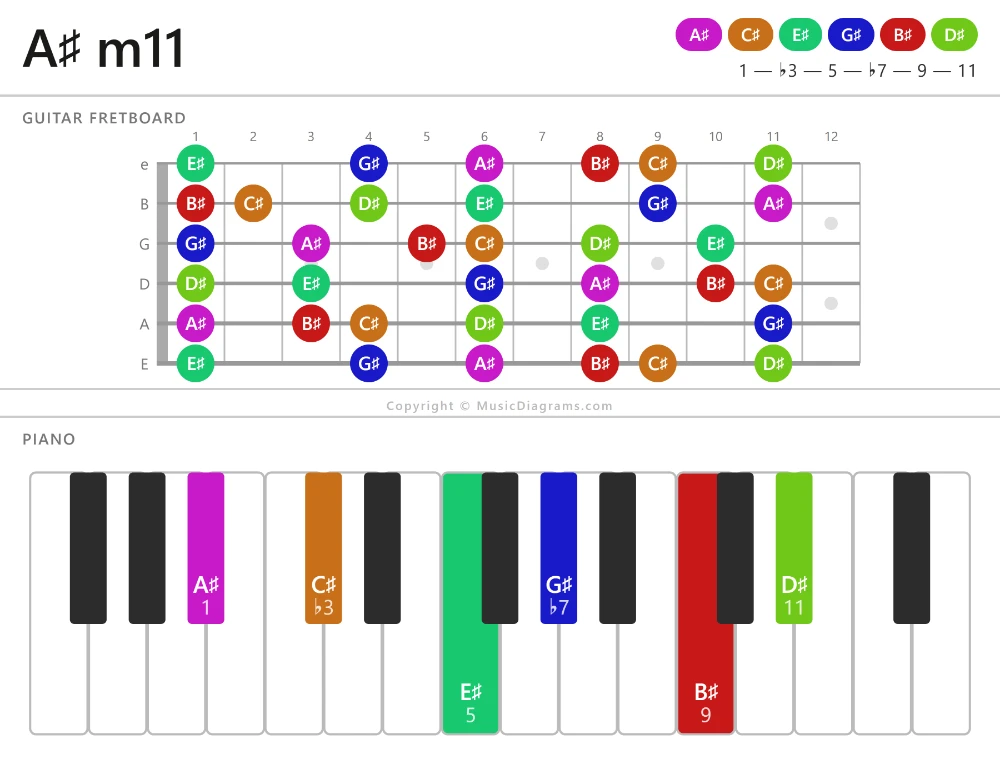
A-sharp minor eleventh is a Minor chord family sonority built from the notes A♯, C♯, E♯, G♯, B♯, and D♯. Its root is A♯, and its interval number formula is 1-♭3-5-♭7-9-11, which gives you the interval names root, minor third, perfect fifth, minor seventh, major ninth, and perfect eleventh. You may also see it written as A♯m11, A♯min11, or A♯-11. If you look at the widget above, you can use it to visualize how these notes stack together and hear the color of the chord clearly. To better understand why these notes create this sound, see chord intervals.
A♯ m11 Alternate Names
- A♯m11
- A♯min11
- A♯-11
A♯ m11 Chord Notes
A♯ m11 Chord Formula
A♯ m11 Chord Notation
How To Use A♯ m11 In Music
Because it combines a minor triad with added upper tones, A♯m11 sounds deep, mellow, jazzy, and slightly dreamy. The minor core gives it a reflective mood, while the 9th and 11th add spaciousness and sophistication rather than harsh tension. This chord can work well in soul, jazz, film music, R&B, and ambient styles, often as a rich tonic, a smooth pre-dominant color, or part of modal harmony. For example, in A♯ minor it might appear as i–VI–III–VII with A♯m11 as the i chord, or in a darker cycle such as iv–i–VI–V. Its mood can feel warmer if followed by major chords, or more unresolved if placed before a tense dominant sonority; if you want to compare that pull, read about a dominant chord.
A♯ m11 Chord Inversions
Inversions happen when a note other than the root is the lowest note. For A♯m11, root position has A♯ in the bass, but you can also use first inversion with C♯ in the bass, second inversion with E♯ in the bass, third inversion with G♯ in the bass, and higher-position bass choices such as B♯ or D♯ for even softer textures. These changes do not alter the chord’s basic identity, but they do change its weight and color: root position feels the most settled, C♯ in the bass can sound gentler, and G♯ or D♯ in the bass can feel more floating or open. Musicians use inversions to create smoother bass lines, connect chords with less jumping, and shape the emotional flow of a progression. Closely related variations may include A♯m9, A♯m7, or fuller voicings that omit the 5th while keeping the 7th, 9th, and 11th for a modern sound.