The A sus4 Chord Explained
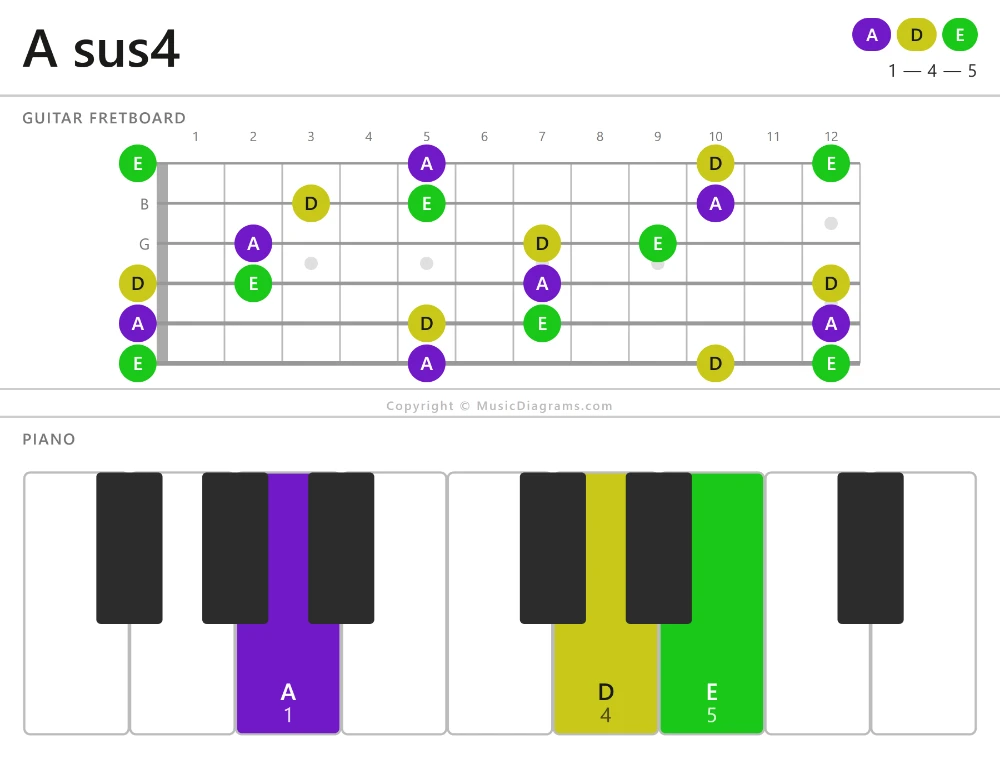
A suspended fourth is a Suspended chord built from the notes A, D, and E. Its root is A, and its interval number formula is 1-4-5, which gives you the interval names root, perfect fourth, and perfect fifth. Because the third is replaced by the fourth, this chord does not sound clearly major or minor, which gives it an open and unresolved quality. If you look at the widget above, you can see these three notes laid out clearly on piano and guitar, and you can also hear them together to connect the shape with the sound. This chord is also commonly called A sus4, Asus4, or plain-text spelling A suspended fourth. To learn more about how these note distances work, see chord intervals.

"1-4-5 That's Sus" T-Shirt
Only True Musicians Get This. For musicians in the know. This funny 1-4-5 suspended chord pun shirt is the perfect gift for guitarists, pianists, music teachers, and music nerds.
A sus4 Alternate Names
- A sus4
- Asus4
- A suspended fourth
A sus4 Chord Notes
A sus4 Chord Formula
A sus4 Chord Notation
How To Use A sus4 In Music
Often, A sus4 sounds bright, airy, and slightly tense because the D wants to move down to C-sharp in an A major chord or sometimes to C in a minor setting. That makes it useful for creating motion without sounding harsh. You will often hear A sus4 used before A major as a gentle resolution, or placed in progressions like Isus4-I in A major, IV–Isus4-I, or V–I when songwriters want a lifted, anticipatory sound. The mood can feel more peaceful if the surrounding chords are stable major chords, but it can feel more dramatic if it appears near minor or dominant harmony. If you want a helpful comparison point, a major chord shows how different the sound becomes once the suspended note resolves.
A sus4 Chord Inversions
Inversions happen when a note other than the root is the lowest note. For A sus4, root position is A-D-E, first inversion is D-E-A, and second inversion is E-A-D. Even though the chord tones stay the same, the lowest note changes the color and balance of the sound. A root-position A sus4 feels the most grounded, while D-E-A can sound softer or more floating, and E-A-D can feel more open and strong because of the fifth in the bass. Players use inversions to make chord changes smoother, create stepwise bass movement, and shape the emotional flow of a progression. You may also hear close voicings and wider voicings of A sus4, which can make the chord sound tighter, fuller, or more spacious while keeping the same suspended identity.