The A♭ 11 Chord Explained
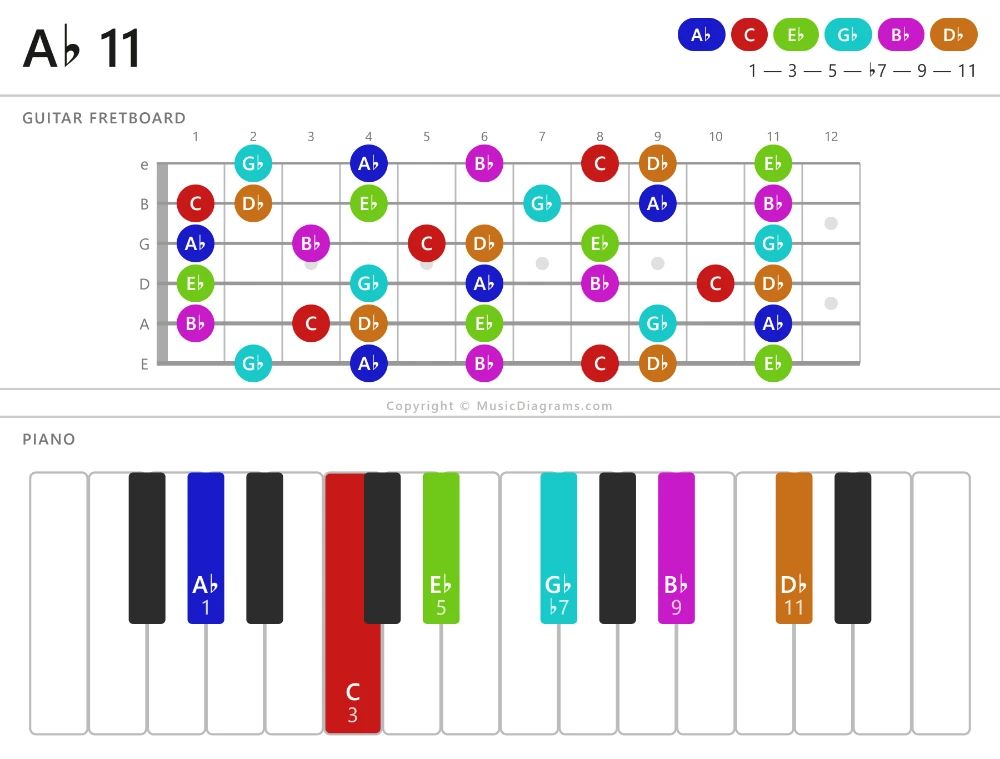
A-flat eleven is a Dominant chord family sound built from the notes A♭, C, E♭, G♭, B♭, and D♭. Its root is A♭, and its interval number formula is 1–3–5–♭7–9–11. Those intervals are called the root, major third, perfect fifth, minor seventh, major ninth, and perfect eleventh. You may also see this chord written as A♭11, A-flat 11, or A-flat dominant 11. If you look at the widget above, you can match these notes on piano and guitar and hear how the stacked tones create a rich extended dominant sound. For a beginner, it can also help to learn how the chord intervals build this chord step by step.
A♭ 11 Alternate Names
- A♭11
- A-flat 11
- A-flat dominant 11
A♭ 11 Chord Notes
A♭ 11 Chord Formula
A♭ 11 Chord Notation
How To Use A♭ 11 In Music
Because it is a dominant-style extended chord, A♭11 often sounds tense, jazzy, colorful, and ready to move somewhere else. The 3rd and ♭7 give it the classic dominant pull, while the 9th and 11th add extra depth and softness around that tension. In music, this chord is often used to lead strongly into a chord a fifth below, so A♭11 commonly resolves to D♭ major or D♭ minor. For example, in the key of D♭ major, it can function as V in a ii–V–I progression such as E♭m7–A♭11–D♭maj7. It may also appear in gospel, soul, funk, or jazz progressions where a fuller dominant color is wanted. The mood can feel brighter or smoother depending on the chords around it: placed after a minor chord it can sound dramatic, while moving into a stable major chord makes its tension feel satisfying. If you want more background on this role, read about what a dominant chord is.
A♭ 11 Chord Inversions
Another useful idea is inversion, which means the chord keeps the same notes but starts from a note other than A♭. In root position, A♭ is the lowest note, but inversions could place C, E♭, G♭, B♭, or D♭ in the bass instead. For example, an A♭11 with C in the bass can sound a little lighter and less grounded, while an A♭11 with G♭ in the bass can bring out more of the dominant tension. These changes do not create a brand-new chord quality, but they do change the weight, color, and direction of the sound. Musicians use inversions to make bass lines smoother, connect chords more naturally, and create a different mood without changing the basic harmonic function of the chord.