The A♭ m Chord Explained
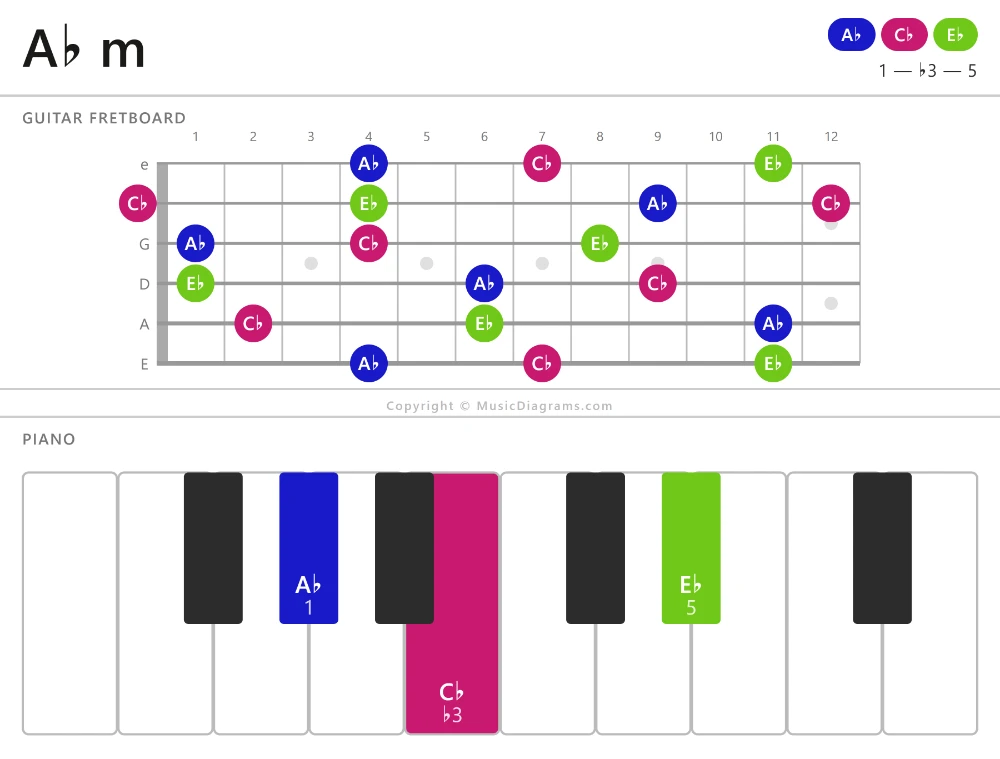
A-flat minor is a Minor chord family chord built from the notes A♭, C♭, and E♭. Its root is A♭, and its interval number formula is 1-♭3-5, which gives you the interval names root, minor third, and perfect fifth. You may also see it written as A♭m, Ab minor, or Abm in plain-text spelling. If you look at the widget above, you can see these three notes laid out on piano and guitar, which makes it easier to connect the chord shape to its sound. To learn more about how these note distances work, see understanding chord intervals.
A♭ m Alternate Names
- A♭m
- Ab minor
- Abm
A♭ m Chord Notes
A♭ m Chord Formula
A♭ m Chord Notation
How To Use A♭ m In Music
Because A-flat minor contains a lowered third, it has the darker, more reflective sound that listeners often associate with minor harmony. It can feel calm, moody, sad, or dramatic depending on tempo, rhythm, and the chords around it. For example, in A♭ minor, A♭m can sound stable as the i chord in a progression like i–VI–III–VII, while in a borrowed or color-based progression it may create contrast against brighter major chords. You might also hear it in patterns such as i–iv–V or i–VI–VII. When the surrounding chords are softer, A♭ minor feels warm and expressive; when followed by tense chords, it can sound more urgent. For a broader beginner-friendly overview, visit what is a minor chord.
A♭ m Chord Inversions
Another useful idea is inversion, which means the chord keeps the same notes but starts on a note other than the root. In root position, A♭ minor is A♭-C♭-E♭. Its first inversion is C♭-E♭-A♭, and its second inversion is E♭-A♭-C♭. These inversions do not change the chord’s identity, but they do change its weight and color. First inversion often sounds a little softer or less final, while second inversion can feel more open or unsettled. Musicians use inversions to make chord changes smoother, create a better bass line, or give a progression a different emotional flow. Common variations related to this chord include adding color tones such as A♭m7 or A♭m(add9), though those are no longer simple triads.