The A m7 Chord Explained
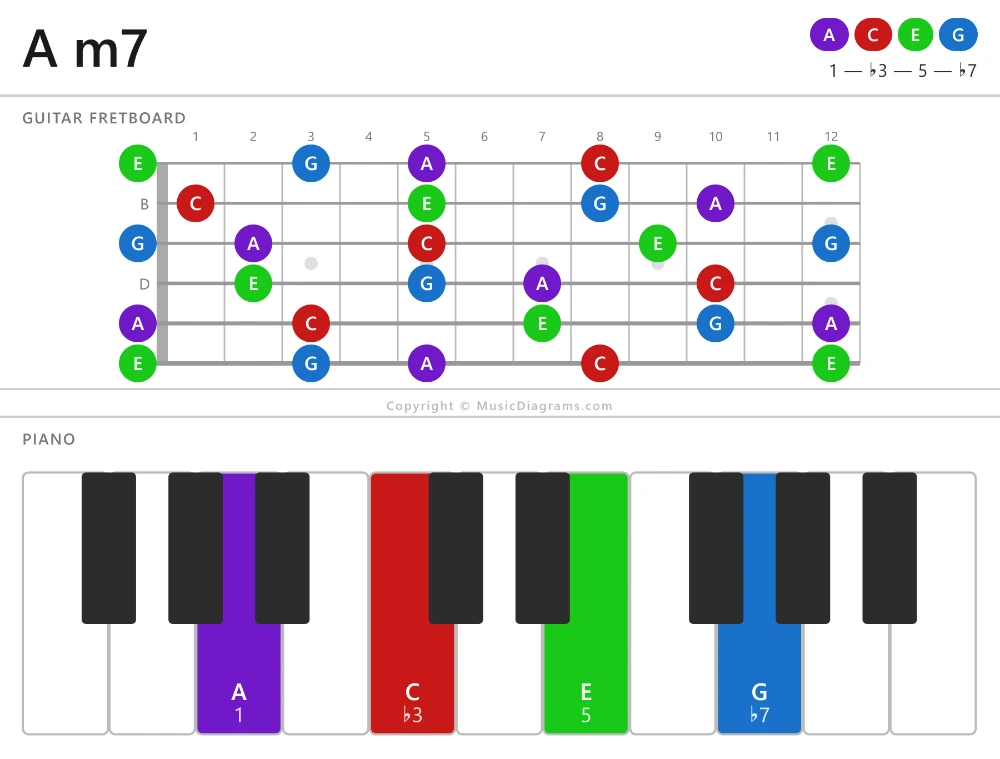
A minor seventh is a Minor chord family chord built from the notes A, C, E, and G. Its root is A, and its interval number formula is 1-♭3-5-♭7, which gives you the interval names root, minor third, perfect fifth, and minor seventh. You may also see it written as Am7, A min7, or A-7. If you are new to chords, the widget above can help you see and hear how these four notes combine, and learning the chord intervals makes the structure much easier to recognize.
A m7 Alternate Names
- Am7
- A min7
- A-7
A m7 Chord Notes
A m7 Chord Formula
A m7 Chord Notation
How To Use A m7 In Music
Often described as warm, mellow, soulful, and slightly reflective, A minor seventh works well in pop, jazz, R&B, funk, and singer-songwriter music. It has a softer and more colorful sound than a plain A minor triad because the added G gives it extra depth. The mood of this chord can change depending on the chords around it: it may sound relaxed in a loop like i-VI-III-VII in A minor, or smoother and more jazzy in progressions such as iv–Am7-VII-III or ii-V-I ideas in G major, where Am7 functions as ii. Next to brighter chords it can sound gentle and emotional, while beside darker minor chords it can feel richer and more introspective. For a beginner, it also helps to understand the chord root so you can spot why A gives this chord its name.
A m7 Chord Inversions
Another useful idea is inversion, which means the notes stay the same but a different chord tone is the lowest note. For A minor seventh, root position is A-C-E-G, while the inversions are first inversion C-E-G-A, second inversion E-G-A-C, and third inversion G-A-C-E. These versions still sound like A minor seventh, but they can change the color and feel: some sound smoother, lighter, or less final because a note other than A is in the bass. Musicians use inversions to make chord changes easier, create better bass movement, and connect harmony more smoothly from one chord to the next. You might also hear close voicings or wider spacings of Am7, but the basic chord tones remain A, C, E, and G.