The A♯ 9 Chord Explained
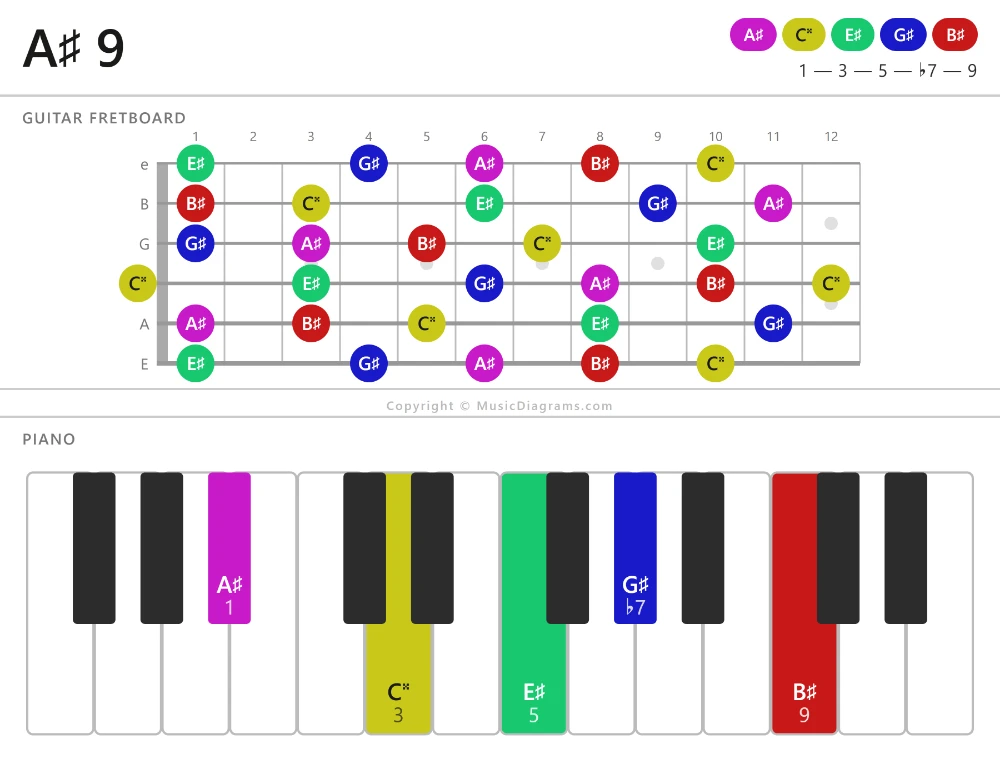
A-sharp ninth is a Dominant chord built from the notes A♯, C♯♯, E♯, G♯, and B♯. Its root is A♯, and its interval number formula is 1–3–5–♭7–9, which gives you the interval names root, major third, perfect fifth, minor seventh, and major ninth. You may also see it written as A♯9, A-sharp 9, or A-sharp dominant ninth. If you look at the widget above, you can use it to see these chord tones laid out clearly on piano and guitar, which makes it easier to connect the note names to the sound. To learn more about how these distances are built, see chord intervals.
A♯ 9 Alternate Names
- A♯9
- A-sharp 9
- A-sharp dominant ninth
A♯ 9 Chord Notes
A♯ 9 Chord Formula
A♯ 9 Chord Notation
How To Use A♯ 9 In Music
Because it includes both a strong major triad and a tense minor seventh with an added ninth, this chord has a bright but restless sound that often wants to move somewhere else. It can feel jazzy, bluesy, punchy, or dramatic depending on the harmony around it. In many songs, A♯9 works like a dominant chord that pushes toward resolution, especially in progressions such as V–I, ii–V–I, or I–vi–ii–V. If the music resolves after it, the chord feels more directional and tense; if it lingers or repeats, it can sound funkier and more colorful. In a blues or jazz setting, it may appear where a dominant chord is needed but with a richer, fuller color than a plain seventh chord.
A♯ 9 Chord Inversions
Another helpful idea for beginners is inversion, which means rearranging the chord so a note other than the root is the lowest pitch. For A-sharp ninth, examples include first inversion with C♯♯ in the bass, second inversion with E♯ in the bass, third inversion with G♯ in the bass, and an inversion with B♯ in the bass. These changes do not alter the chord’s basic identity, but they do change its weight, smoothness, and sense of motion. A root-position voicing often sounds strongest and most direct, while inversions can sound softer, more flowing, or better connected to nearby chords. Musicians use inversions to create smoother bass lines, reduce big jumps between chords, and shape the mood of a progression with more control.