The A♯ maj9 Chord Explained
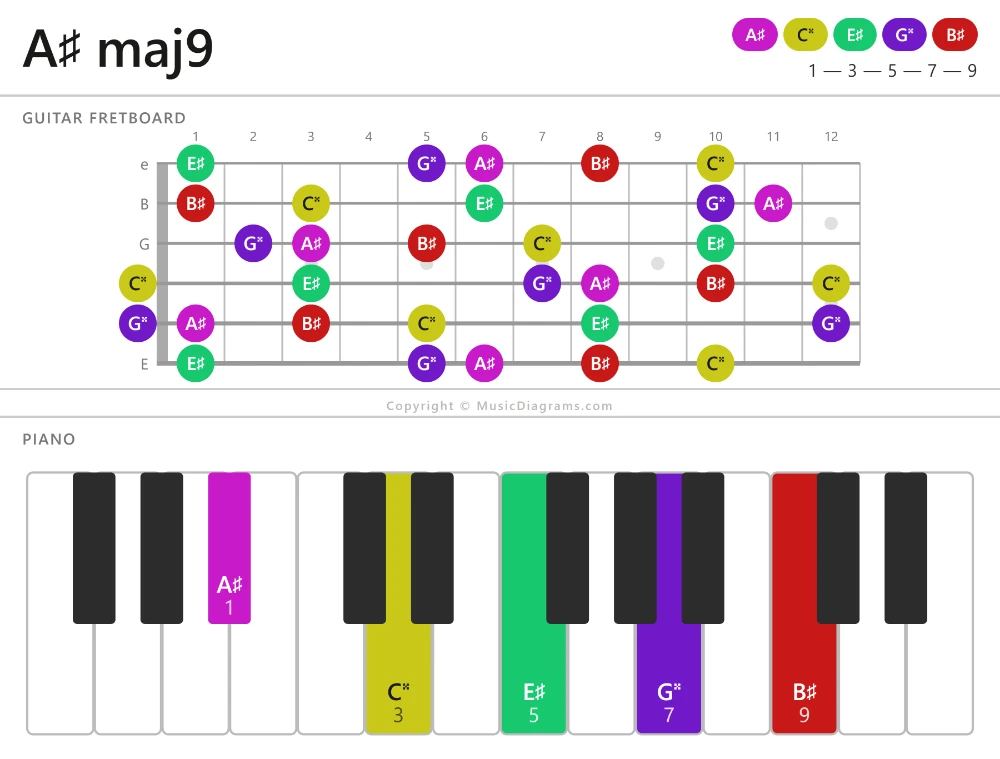
A-sharp major ninth is a Major chord family sonority built from the notes A♯, C♯♯, E♯, G♯♯, and B♯. Its root is A♯, and its interval number formula is 1–3–5–7–9, which gives you the interval names root, major third, perfect fifth, major seventh, and major ninth. You may also see this chord written as A♯maj9, A♯M9, or A♯Δ9, all meaning the same basic sound. If you are new to chord structure, the widget above can help you see and hear how these notes stack together, and you can learn more about chord intervals to understand why this chord has such a rich color.
A♯ maj9 Alternate Names
- A♯maj9
- A♯M9
- A♯Δ9
A♯ maj9 Chord Notes
A♯ maj9 Chord Formula
A♯ maj9 Chord Notation
How To Use A♯ maj9 In Music
Because it combines a bright major triad with the smooth color of a major seventh and ninth, this chord sounds lush, polished, and expressive. It often creates a dreamy, elegant, or jazzy mood, but the feeling can change depending on the chords around it. For example, A♯maj9 might act as I in a progression like I–vi–ii–V, or appear as IV in a warmer movement such as ii–V–IV–I in a different key context. Placed after tenser chords, it can feel like a beautiful release, while beside other soft major or minor chords it can sound gentle and floating. Since its base quality is major, it can also help to compare it with what makes a major chord sound stable and bright.
A♯ maj9 Chord Inversions
Inversions happen when a note other than the root is the lowest note. For A♯maj9, root position has A♯ on the bottom, while inversions could place C♯♯, E♯, G♯♯, or B♯ in the bass. An inversion does not change the chord’s name family, but it does change the weight and color of the sound. For instance, putting the third in the bass can make the chord feel smoother and less final, while a seventh or ninth in the bass can sound more delicate, tense, or atmospheric. Players use inversions to create stepwise bass lines, smoother transitions between chords, and a more connected sound in progressions, especially in styles like pop, soul, jazz, and film music.