The A♯ Major Chord Explained
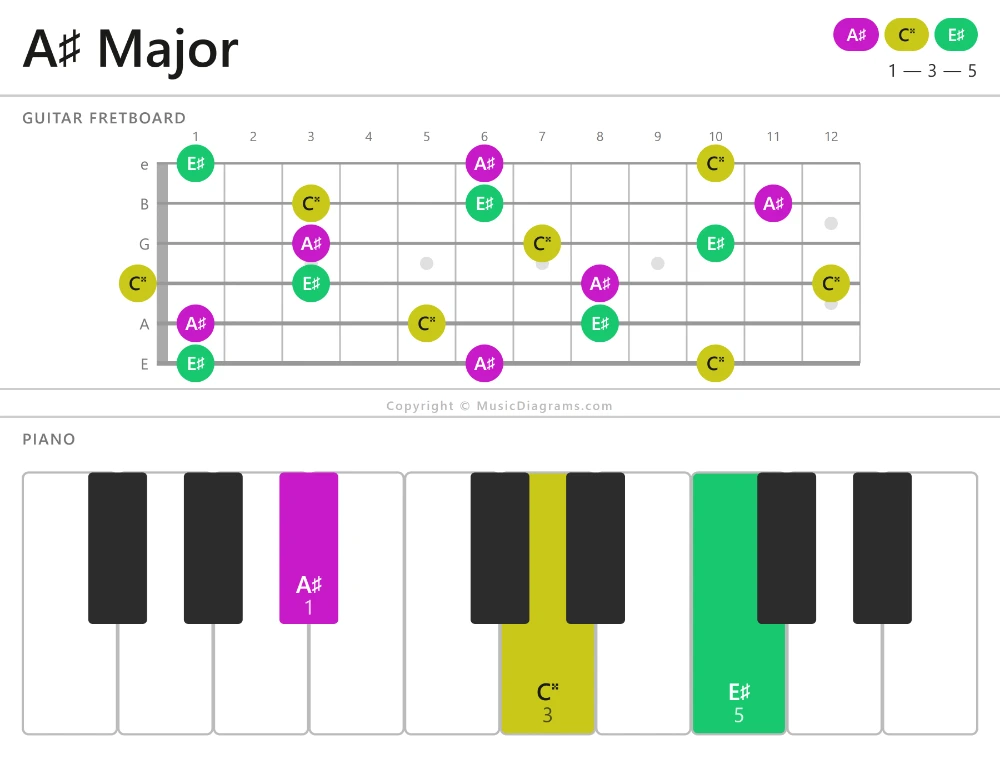
A-sharp major is a Major chord built from the notes A♯, C♯♯, and E♯. Its root is A♯, which is the note the chord is named after, and its interval number formula is 1–3–5. That means the chord contains a root, a major third, and a perfect fifth. If you look at the widget above, you can see and hear these three chord tones clearly, which is helpful for beginners learning how the notes fit together. A♯ major may also be written as A♯ maj or A♯ major triad, and you can learn more about how these distances work in chord intervals.
A♯ Major Alternate Names
- A♯ maj
- A♯ major triad
- A-sharp major
A♯ Major Chord Notes
A♯ Major Chord Formula
A♯ Major Chord Notation
How To Use A♯ Major In Music
Because it is a major chord, A♯ major usually sounds bright, stable, and confident. It can create a cheerful or strong feeling on its own, but the mood can change depending on the chords around it. For example, A♯ major can sound like home when used as I in a progression such as I–IV–V, or it can feel like a lift in color when placed in a sequence like vi–I–V. In some keys, it may also appear briefly as a borrowed or less common chord choice. If you are new to harmony, it can help to compare this sound with other major chords so you can recognize its clear and balanced character.
A♯ Major Chord Inversions
Another useful idea for beginners is inversion, which means playing the same chord with a note other than the root at the bottom. In root position, A♯ major is A♯–C♯♯–E♯. Its first inversion is C♯♯–E♯–A♯, and its second inversion is E♯–A♯–C♯♯. These inversions do not change the chord’s identity, but they do change its sound and feel. First inversion often sounds a little softer or less final, while second inversion can sound more open or more tense depending on the musical setting. Musicians use inversions to create smoother movement between chords, make bass lines easier to sing or play, and give a progression a different shape without changing the basic harmony.