The B 7♭9 Chord Explained
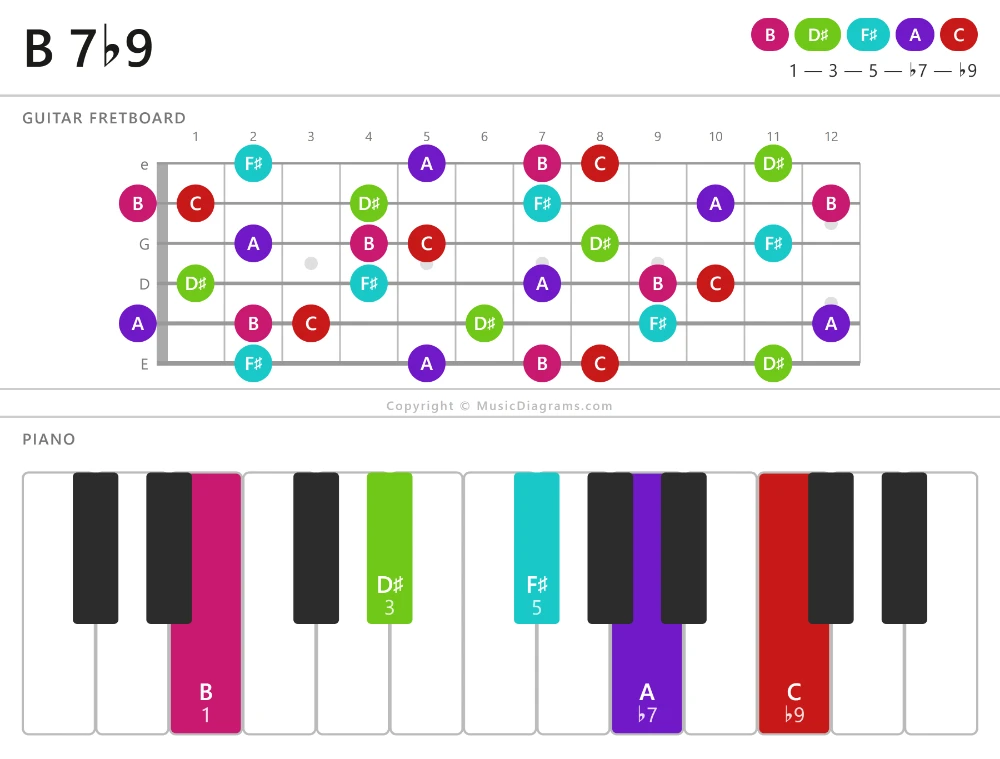
B seven flat nine is a Dominant chord family member built from the notes B, D♯, F♯, A, and C. Its root is B, and its interval number formula is 1–3–5–♭7–♭9. That means the interval names are root, major third, perfect fifth, minor seventh, and minor ninth. You may also see it written as B7♭9, B dominant seventh flat ninth, or B seven flat nine. If you look at the widget above, you can match these chord tones on piano or guitar and hear how each note adds tension around the root; if you want to learn more about how these distances work, see chord intervals.
B 7♭9 Alternate Names
- B7♭9
- B dominant seventh flat ninth
- B seven flat nine
B 7♭9 Chord Notes
B 7♭9 Chord Formula
B 7♭9 Chord Notation
How To Use B 7♭9 In Music
Because this chord includes both a strong dominant seventh sound and the extra bite of a flat ninth, it usually sounds tense, dramatic, and full of pull toward another chord. Beginners often hear B7♭9 as a chord that wants to resolve, especially to E or E minor, so it commonly appears as V moving to i or I, such as iii–vi–V–i in E minor or ii–V–I in E major when extra color is desired. In a progression like F♯m–B7♭9–E, the chord creates suspense before the release of E, while in darker settings it can lead to Em for a more dramatic effect. The mood can feel jazzy, bluesy, classical, or even ominous depending on the chords around it, and you can compare its basic pull with a dominant chord.
B 7♭9 Chord Inversions
Another useful idea is inversion, which means the root is no longer the lowest note. In root position, B is the lowest note, but inversions place D♯, F♯, A, or even C in the bass, creating forms such as B7♭9/D♯, B7♭9/F♯, B7♭9/A, and B7♭9/C. These versions keep the same chord quality but can change the weight, smoothness, and tension of the sound. For example, putting D♯ or F♯ in the bass can make the chord feel more flowing in a progression, while A or C in the bass can sound more unstable and urgent. Musicians use inversions to connect chords more smoothly, shape the bass line, and control how strongly the chord pushes toward resolution.