The B♭ 6 Chord Explained
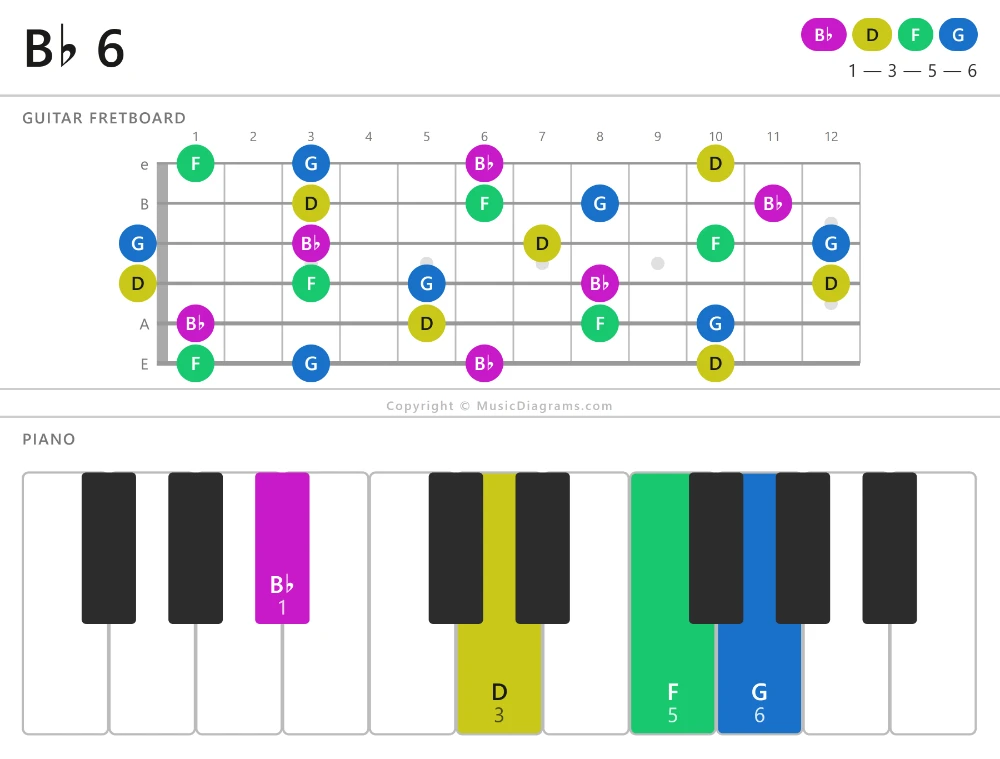
B-flat sixth is a Major chord family chord built from the notes B-flat, D, F, and G. Its root is B-flat, and its interval number formula is 1-3-5-6, which gives you the interval names root, major third, perfect fifth, and major sixth. You may also see it written as B-flat 6, Bb6, or B-flat major sixth. If you look at the widget above, you can see and hear how these four notes combine, and learning a little about chord intervals can make this shape even easier to understand.
B♭ 6 Alternate Names
- B-flat 6
- Bb6
- B-flat major sixth
B♭ 6 Chord Notes
B♭ 6 Chord Formula
B♭ 6 Chord Notation
How To Use B♭ 6 In Music
Often, B-flat sixth sounds warm, gentle, settled, and a little more colorful than a plain B-flat major chord because the added sixth gives it a soft, sweet flavor. It can work well in pop, jazz, oldies, country, and film music when you want a major sound that feels relaxed instead of overly bright. Its mood can change depending on the chords around it: after E-flat it may sound stable and comforting, while before F or F7 it can feel like a smooth passing color. For example, in B-flat major you might hear I–IV–B-flat 6–V, or written fully as I–IV–I6–V. In another setting, it could appear in a progression like Gm–E-flat–B-flat 6–F, where the chord acts as I6 and adds extra warmth to the tonic area. If you are new to harmony, it also helps to know the chord root because that is the note the chord is named after.
B♭ 6 Chord Inversions
Another useful idea is inversion, which means the chord keeps the same notes but starts from a different one in the bass. For B-flat sixth in root position, B-flat is the lowest note, but inversions could place D, F, or G at the bottom. A version with D in the bass can sound smoother when moving step by step from one chord to another, while F or G in the bass can make the chord feel lighter, less final, or more flowing. Players use inversions to create better voice leading, connect chords with less movement, and shape the mood of a progression without changing the basic chord quality. You may also hear close voicings and wider voicings of B-flat sixth, and those spacing choices can make it sound either more compact and gentle or more open and spacious.