The B♭ 7sus4 Chord Explained
B-flat dominant seventh suspended fourth is a Dominant-family chord built from the notes B♭, E♭, F, and A♭. Its root is B♭, and its interval formula is 1–4–5–♭7, which gives you the interval names root, perfect fourth, perfect fifth, and minor seventh. Because the third is replaced by a fourth, this chord has an open, suspended sound rather than a clearly major or minor color. You may also see it written as B♭7sus4, B-flat 7sus4, or B♭ dominant seventh suspended fourth. If you are new to chord structure, the widget above can help you match these notes to the shape, and this guide to chord intervals explains how those note distances create the chord’s sound.
B♭ 7sus4 Alternate Names
- B♭7sus4
- B-flat 7sus4
- B-flat dominant seventh suspended fourth
B♭ 7sus4 Chord Notes
B♭ 7sus4 Chord Formula
B♭ 7sus4 Chord Notation
How To Use B♭ 7sus4 In Music
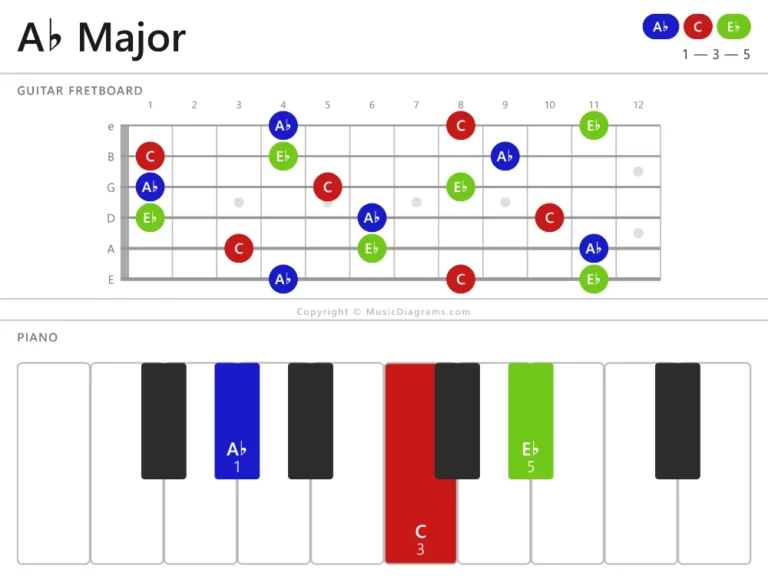
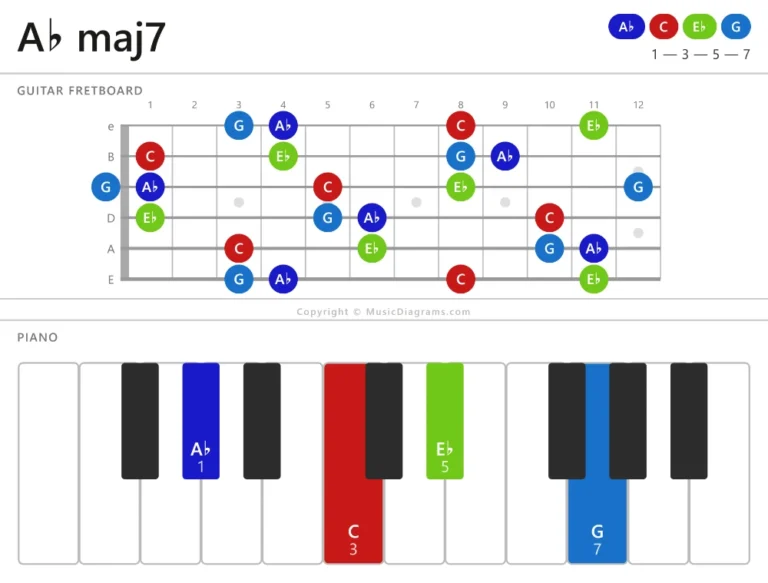
Often, this chord sounds tense, expectant, and slightly soulful, as if it is waiting to resolve. The suspended fourth softens the usual bite of a dominant seventh chord while still keeping strong forward motion, so B♭7sus4 works well in rock, pop, blues, gospel, and funk. For example, in the key of E♭ major, B♭7sus4 can function as V before resolving to E♭, as in ii–V–I or IV–V–I. In A♭ major, it can also appear as ii–V–I with E♭m7–B♭7sus4–A♭maj7. The mood changes depending on the chords around it: after a calm chord it can sound more dramatic, but before a stable tonic chord it creates a satisfying release. To compare its role with similar tension-building harmony, see this overview of dominant chords.
B♭ 7sus4 Chord Inversions
Inversions happen when a note other than the root is the lowest note. For B♭7sus4 in root position, B♭ is the bass note, but you can also hear first inversion with E♭ in the bass, second inversion with F in the bass, and third inversion with A♭ in the bass. These inversions keep the same four notes—B♭, E♭, F, and A♭—but change the weight and feel of the chord. A root-position voicing sounds grounded and direct, while an inversion can sound smoother, lighter, or more flowing, especially when connecting one chord to the next. Players use inversions to improve voice leading, reduce big jumps between bass notes, and create a different color without changing the chord’s basic function.