The B♭ add9 Chord Explained
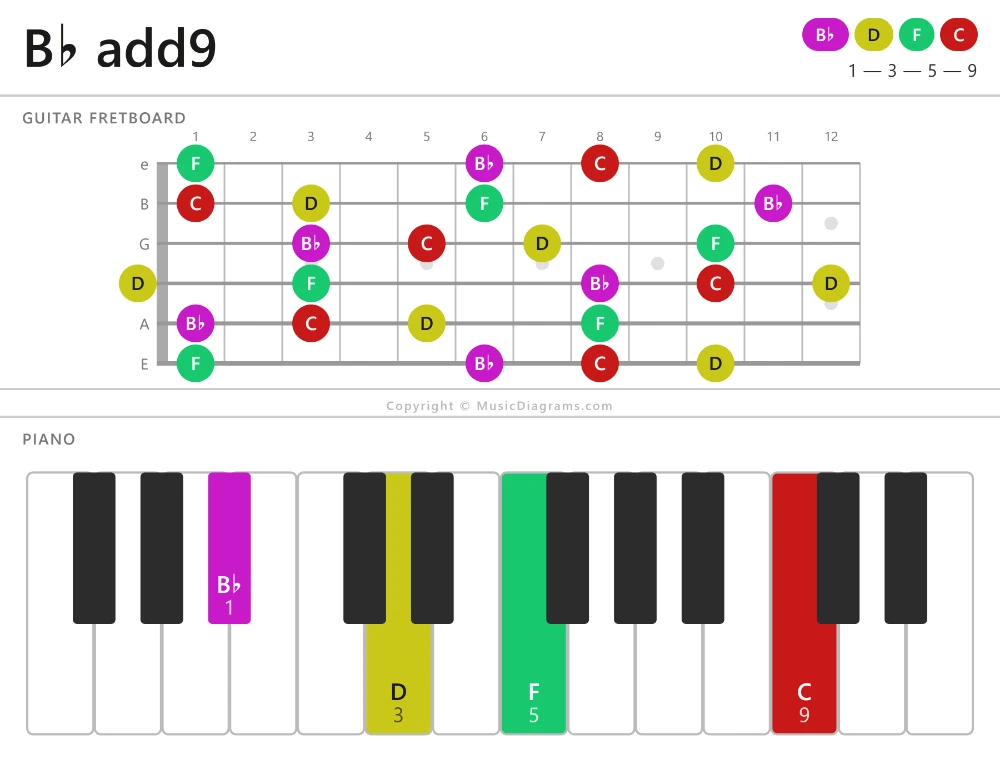
B-flat add nine is an added-tone chord in the Major family. It uses the notes B-flat, D, F, and C. The root is B-flat, and the interval number formula is 1–3–5–9. Those intervals are called the root, major third, perfect fifth, and ninth. You may also see this chord written as B-flat add9, B-flat add 9, or Bbadd9. If you look at the widget above, you can use it to visualize where these chord tones sit and hear how the notes work together. To better understand how these notes are stacked, see chord intervals.
B♭ add9 Alternate Names
- B-flat add9
- B-flat add 9
- Bbadd9
B♭ add9 Chord Notes
B♭ add9 Chord Formula
B♭ add9 Chord Notation
How To Use B♭ add9 In Music
Because it is built from a major triad with an added ninth, this chord sounds bright, open, and a little more colorful than a plain B-flat major chord. The added C gives it a gentle shimmer without making it sound as tense as a seventh chord. In music, B-flat add9 can be used to make a progression feel warmer, fuller, or more expressive. Its mood can change depending on the chords around it: next to simple major chords it can sound sweet and spacious, while beside darker chords it can add contrast. For example, in B-flat major you might hear I–V–vi–IV as B-flat add9–F–Gm–E-flat, or a softer pop-style loop such as I–IV–vi–V with B-flat add9–E-flat–Gm–F. If you want a refresher on the basic sound beneath this color tone, read about what is a major chord.
B♭ add9 Chord Inversions
Another useful idea for beginners is inversion, which means playing the same chord with a note other than the root at the bottom. For B-flat add9, root position is B-flat–D–F–C, while inversions can place D, F, or C in the bass. For example, you might see D–F–C–B-flat, F–C–B-flat–D, or C–B-flat–D–F. These are still forms of B-flat add9, but they sound a little different because the lowest note changes the chord’s weight and color. Inversions can make the chord feel smoother, lighter, or more flowing, especially when moving from one chord to the next. Players often use them to create easier transitions, a gentler bass line, or a fresh texture while keeping the same overall harmony.