The B m6/9 Chord Explained
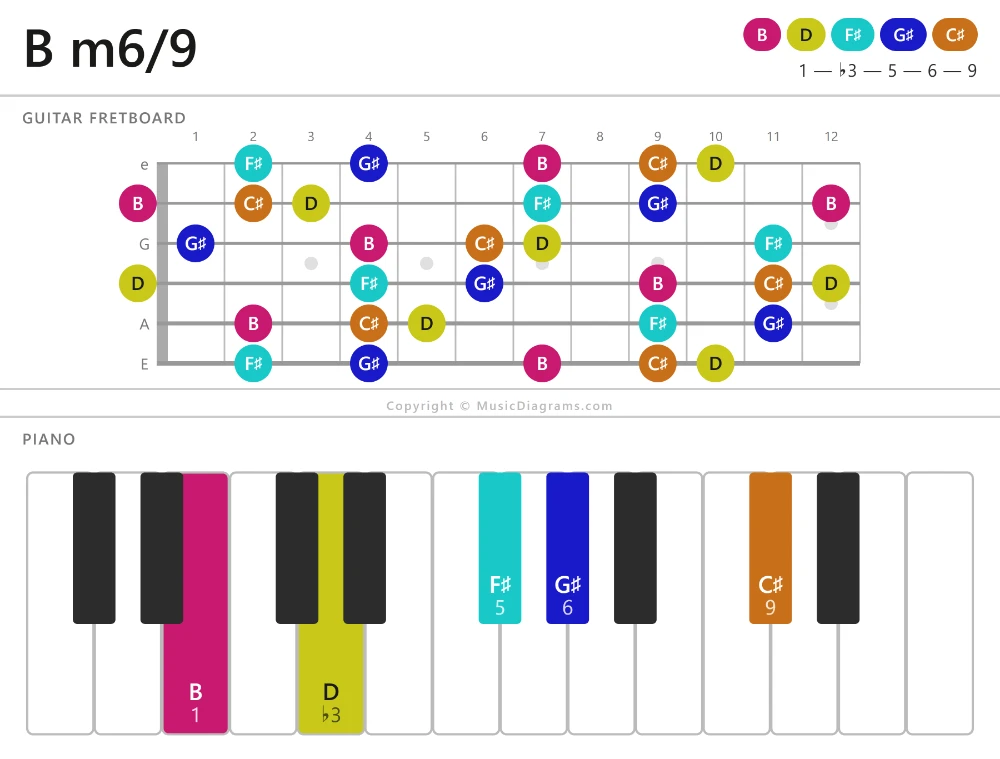
B minor six add nine is a Minor chord family color chord built from the notes B, D, F♯, G♯, and C♯. Its root is B, and its interval number formula is 1-♭3-5-6-9, which gives you the interval names root, minor third, perfect fifth, major sixth, and major ninth. You may also see it written as Bm6/9, Bmin6/9, or B minor 6/9. For a beginner, this chord can feel rich but still gentle, because it starts with a basic minor sound and adds two brighter color tones. The widget above can help you see and hear how these notes work together, and if you want to learn more about how these distances are built, see chord intervals.
B m6/9 Alternate Names
- Bm6/9
- Bmin6/9
- B minor 6/9
B m6/9 Chord Notes
B m6/9 Chord Formula
B m6/9 Chord Notation
How To Use B m6/9 In Music
Because B minor six add nine blends a sadder minor core with warmer extensions, it often sounds reflective, smooth, dreamy, or jazzy rather than dark or harsh. In a progression, it can act as a colorful home chord or as a softer passing sound, and the chords around it strongly affect its mood: next to brighter major chords it can feel wistful, while next to tenser chords it can sound more mysterious. For example, in B minor you might hear i–VII–VI–VII as Bm6/9–A–G–A, or a gentler cycle such as VI–i–iv–V as G–Bm6/9–Em–F♯. If you are new to harmony, it may help to compare its base quality with a minor chord, then notice how the 6 and 9 make the sound more open and expressive.
B m6/9 Chord Inversions
Another useful idea is inversion, which means the chord keeps the same notes but a note other than the root is placed in the bass. For B minor six add nine, root position has B as the lowest note, while inversions could place D, F♯, G♯, or C♯ in the bass. A D-in-the-bass version can sound softer and less settled, while an F♯ bass may feel more stable and flowing in a progression. Inversions are often used to make bass lines smoother, connect chords more naturally, or change the weight of the harmony without changing the chord’s identity. You might also hear simpler related variations such as Bm, Bm6, or Bmadd9, each keeping some of the same character while changing the color and tension.