The B maj7 Chord Explained
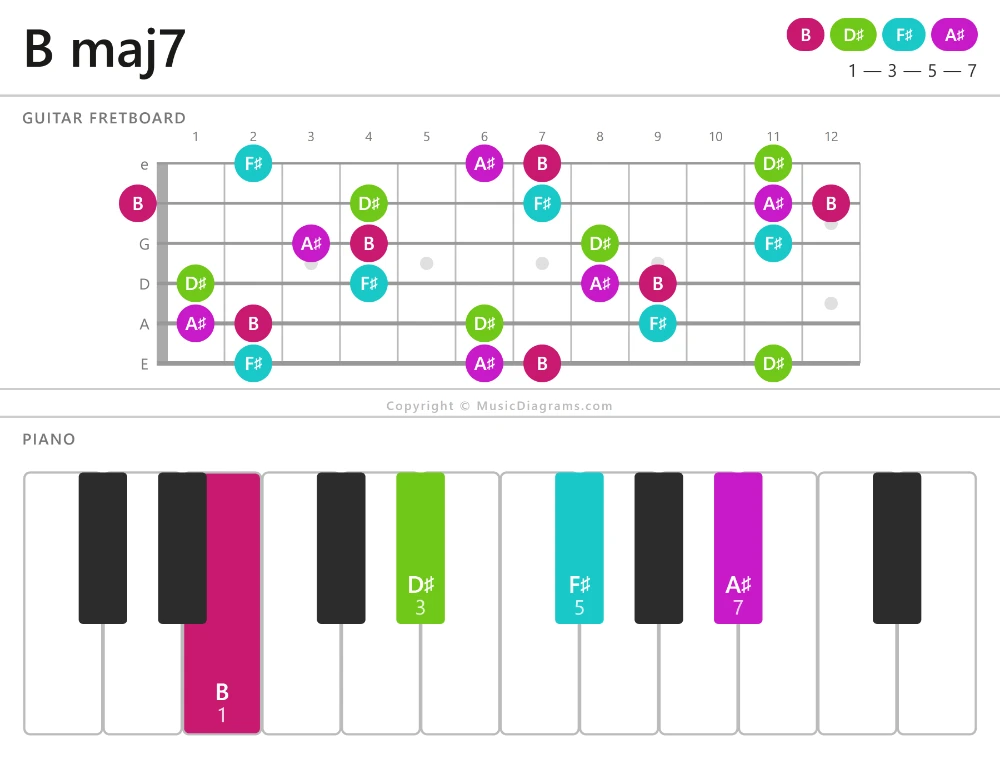
B major seventh is a Major chord family chord built from the notes B, D♯, F♯, and A♯. Its root is B, and its interval number formula is 1–3–5–7, which gives you the interval names root, major third, perfect fifth, and major seventh. You may also see it written as Bmaj7, BM7, or BΔ7, all of which mean the same chord in plain-text spelling: B major seventh. If you look at the widget above, you can use the piano and guitar diagrams to spot these notes clearly and hear how they blend together. To understand why these notes create this sound, it helps to learn more about chord intervals.
B maj7 Alternate Names
- Bmaj7
- BM7
- BΔ7
B maj7 Chord Notes
B maj7 Chord Formula
B maj7 Chord Notation
How To Use B maj7 In Music
Often described as smooth, rich, warm, and dreamy, the B major seventh chord can create a calm, polished, or slightly jazzy mood. It works well in pop, jazz, soul, R&B, and film music when a plain major chord feels too simple. In the key of B major, it can appear as I in a progression like I–vi–ii–V, or move gently in patterns such as I–IV–V–I. It may also sound beautiful when followed by chords that add contrast, because the surrounding harmony can make Bmaj7 feel more restful, more emotional, or more dramatic. If you want a helpful comparison with a simpler bright chord sound, read about what is a major chord.
B maj7 Chord Inversions
Another useful idea is inversion, which means changing which note is at the bottom while keeping the same four notes of the chord. For B major seventh, root position is B–D♯–F♯–A♯, first inversion is D♯–F♯–A♯–B, second inversion is F♯–A♯–B–D♯, and third inversion is A♯–B–D♯–F♯. These inversions do not change the chord’s name family, but they do change its color and balance. A root-position Bmaj7 usually sounds most settled, while inversions can feel smoother, lighter, or more flowing, especially when connecting to nearby chords. Players use inversions to make progressions easier to play, reduce large jumps between chords, and create a softer or more elegant movement in the harmony.