The B♯ 7♭9 Chord Explained
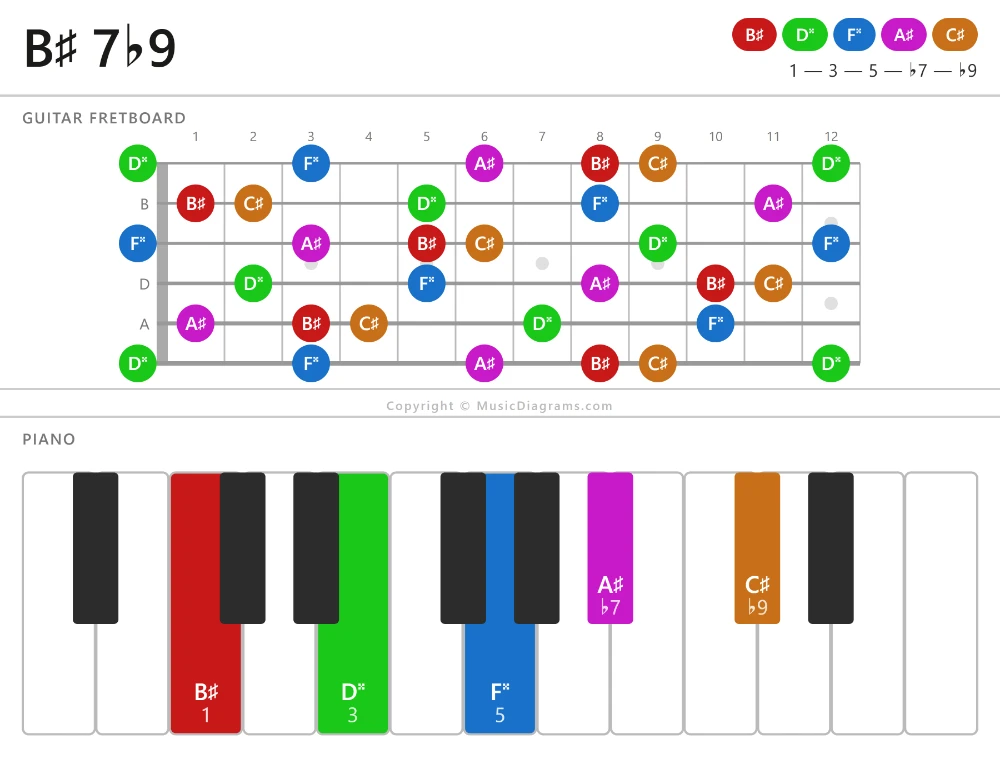
B-sharp dominant seventh flat ninth is a Dominant chord built from the notes B♯, D♯♯, F♯♯, A♯, and C♯. Its root is B♯, and its interval number formula is 1–3–5–♭7–♭9, which gives you the interval names root, major third, perfect fifth, minor seventh, and minor ninth. You may also see this chord written as B♯7♭9, B♯ dominant 7 flat 9, or B♯ seven flat nine. If you look at the widget above, you can match these chord tones to the piano and guitar diagrams and hear how the stacked intervals create tension; if you are new to this idea, this guide to chord intervals can help.
B♯ 7♭9 Alternate Names
- B♯7♭9
- B-sharp dominant 7 flat 9
- B-sharp seven flat nine
B♯ 7♭9 Chord Notes
B♯ 7♭9 Chord Formula
B♯ 7♭9 Chord Notation
How To Use B♯ 7♭9 In Music
Because it is a dominant-type sonority with an added flat ninth, this chord sounds tense, bright, and unstable, with a strong pull toward resolution. The major third and minor seventh create the classic dominant sound, while the flat ninth adds extra bite and drama, so it often appears right before a chord that feels more settled. For example, in a key where this chord functions as V, B♯7♭9 can resolve to I in a progression like ii–V–I, or it might appear in a longer chain such as iii–vi–ii–V–I. The mood can feel jazzy, suspenseful, or even dark depending on the surrounding harmony, and if you want to compare its role with other tension-building chords, you can read more about dominant chords.
B♯ 7♭9 Chord Inversions
Inversions happen when a note other than the root is placed in the bass, which changes the weight and color of the chord without changing its basic identity. For B♯7♭9 in root position, B♯ is the lowest note, but inversions could place D♯♯, F♯♯, A♯, or C♯ in the bass. A first inversion has D♯♯ in the bass, a second inversion has F♯♯ in the bass, a third inversion has A♯ in the bass, and a fourth inversion places C♯ in the bass. These versions can sound smoother or more dramatic depending on the bass movement, which is why composers and songwriters use them to connect chords more easily, shape a melody line, or make a resolution feel softer or stronger. Closely related variations may include leaving out the fifth in some settings or emphasizing the flat ninth for extra tension.