The B♯ 9 Chord Explained
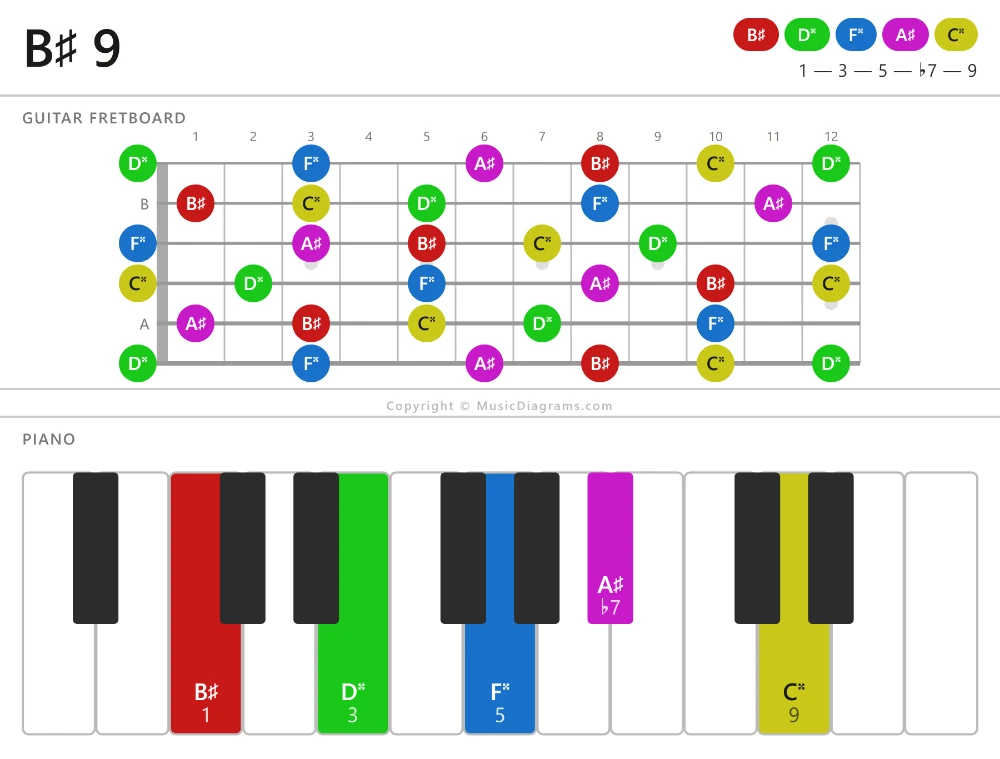
B-sharp ninth is a Dominant chord family chord built from the notes B♯, D♯♯, F♯♯, A♯, and C♯♯. Its root is B♯, and its interval number formula is 1–3–5–♭7–9, which gives you the interval names root, major third, perfect fifth, minor seventh, and major ninth. You may also see this chord written as B♯9, B-sharp dominant ninth, or B♯ dominant 9th. If you look at the widget above, you can match these chord tones to the fretboard or piano diagram and hear how they combine; this can also help you understand how the notes are stacked by interval. For a closer look at how these distances work, see understanding chord intervals.
B♯ 9 Alternate Names
- B♯9
- B-sharp dominant ninth
- B♯ dominant 9th
B♯ 9 Chord Notes
B♯ 9 Chord Formula
B♯ 9 Chord Notation
How To Use B♯ 9 In Music
Because it contains both a strong major triad and a tense minor seventh with an added ninth, this chord sounds bright, restless, and full of forward motion. It often creates a feeling that wants to resolve, which is why dominant ninth chords are common before a home chord or tonic. In progressions, B♯9 could function like V9 moving to I, or appear in jazz and blues-style movement such as ii–V9–I. For example, it might be heard in patterns like Fm7–B♯9–E♯maj7, where the surrounding chords make its tension feel smoother or sharper depending on the musical context. If you want to compare this role with the broader dominant sound, read what is a dominant chord.
B♯ 9 Chord Inversions
Another useful idea is inversion, which means playing the same chord with a note other than the root at the bottom. For B♯9, root position places B♯ lowest, while inversions could place D♯♯, F♯♯, A♯, or even C♯♯ in the bass. These choices do not change the chord’s identity, but they do change its weight, color, and smoothness. A third in the bass can sound more stable and connected, while the seventh or ninth in the bass can sound more tense or modern. Musicians use inversions to create smoother bass lines, connect chords with less movement, and shape the mood of a progression without changing the basic harmony.