The B♯ add9 Chord Explained
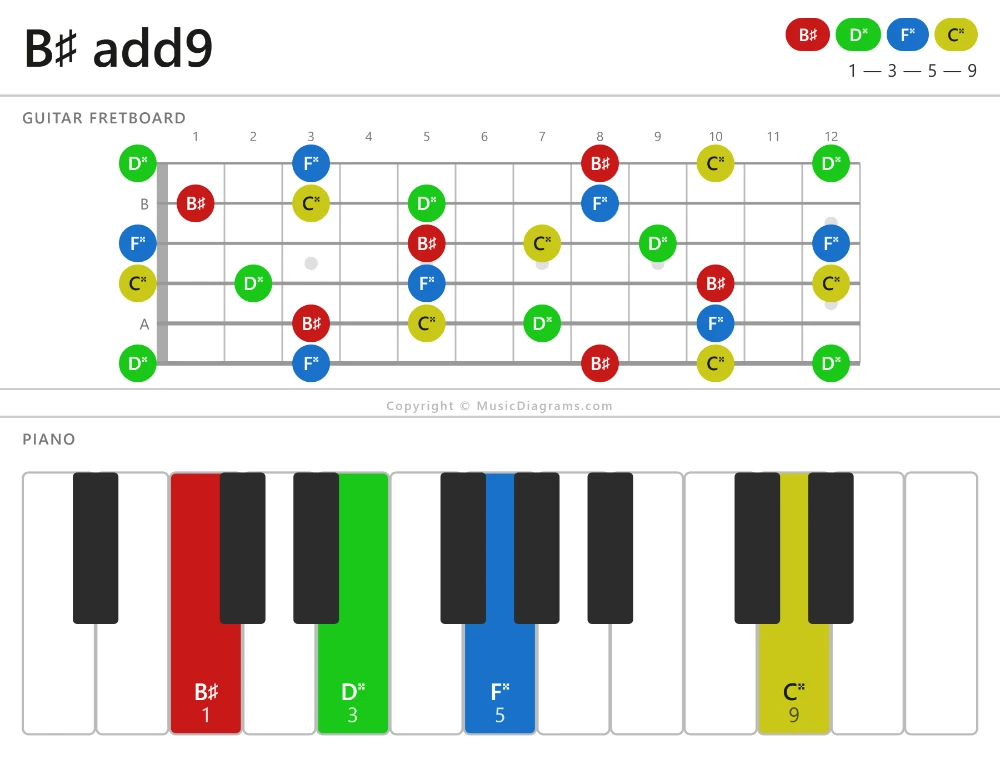
B-sharp add nine is an added-note chord in the Major family. It uses the notes B♯, D♯♯, F♯♯, and C♯♯. The root is B♯, which is the note that gives the chord its name and tonal center. Its interval number formula is 1–3–5–9, and those intervals are called the root, major third, perfect fifth, and major ninth. You may also see it written as B♯add9 or B♯ add 9, and the plain-text spelling is B-sharp add nine. If you look at the widget above, you can match these chord tones to the keyboard and fretboard shapes while learning how each note relates to the chord root.
B♯ add9 Alternate Names
- B♯add9
- B♯ add 9
- B-sharp add nine
B♯ add9 Chord Notes
B♯ add9 Chord Formula
B♯ add9 Chord Notation
How To Use B♯ add9 In Music
Because it is built from a major triad with an added ninth, this chord sounds bright, open, and slightly shimmering. The extra ninth gives it more color than a plain major chord without making it as tense as a seventh chord, so it often works well in pop, worship, rock, film, and singer-songwriter styles. For example, in a key where this chord functions as I, you might hear B♯add9 used in a progression like I–vi–IV–V, or placed before a stronger pull such as ii–V–I. Its mood can feel more peaceful when surrounded by stable major chords, or more emotionally expressive when it appears next to minor chords. To better understand why the added ninth changes the color of the chord, it helps to study chord intervals.
B♯ add9 Chord Inversions
Inversions happen when a note other than the root is the lowest note. For B-sharp add nine, root position has B♯ on the bottom, while inversions could place D♯♯, F♯♯, or even C♯♯ in the bass. A first inversion would use D♯♯ as the lowest note, and that usually sounds a bit softer and less grounded than root position. With F♯♯ in the bass, the chord can feel more stable but also more spread out, while C♯♯ in the bass can highlight the added color of the ninth and make the harmony feel more floating or modern. Players use inversions to create smoother bass lines, connect chords with less movement, and slightly change the mood without changing the basic identity of the chord.