The B♯ m Chord Explained
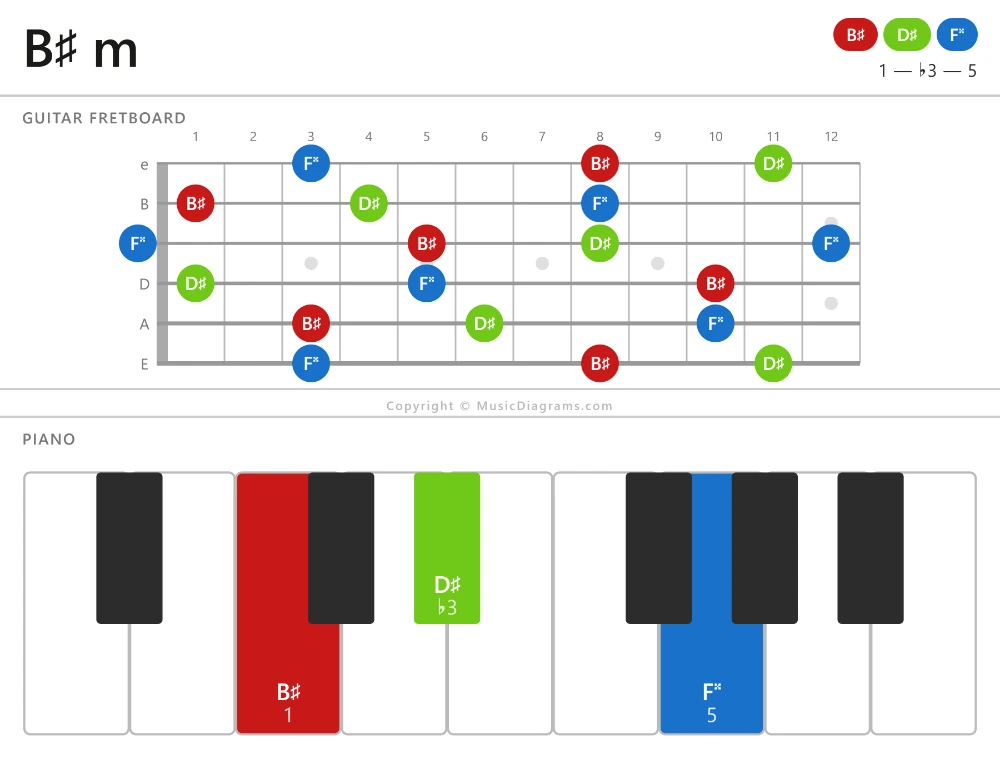
B-sharp minor is a Minor chord made from the notes B-sharp, D-sharp, and F-double-sharp. Its root is B-sharp, and its interval number formula is 1-♭3-5. These intervals are called the root, minor third, and perfect fifth. If you look at the widget above, you can see and hear how these three notes combine to make the chord shape and sound. To understand why these note distances create a minor sound, see chord intervals. This chord may also be written with the symbol B♯m or in plain text as B-sharp minor.
B♯ m Alternate Names
- B♯m
- B-sharp minor
B♯ m Chord Notes
B♯ m Chord Formula
B♯ m Chord Notation
How To Use B♯ m In Music
Often, B-sharp minor sounds dark, gentle, and a little tense, which is typical of a minor chord. On its own, it can feel thoughtful or emotional, but the chords around it can make it sound sadder, warmer, or more dramatic. For example, B♯m might appear as ii in a minor-style progression such as i-ii-V-i, or as vi in a major-style progression like I-V-vi-IV. In practice, musicians choose it for contrast, motion, or color, especially when moving between brighter and darker harmonies. If you want a broader beginner-friendly explanation of this sound family, read more about minor chords.
B♯ m Chord Inversions
Inversions happen when a note other than the root is the lowest note. In root position, B-sharp minor is B-sharp-D-sharp-F-double-sharp. In first inversion, D-sharp is the lowest note, written as D-sharp-F-double-sharp-B-sharp. In second inversion, F-double-sharp is the lowest note, written as F-double-sharp-B-sharp-D-sharp. These inversions still contain the same three notes, but they can feel smoother, lighter, or less settled because the bass note changes. Players use inversions to connect chords more smoothly, create better bass lines, and change the mood slightly without changing the basic identity of the chord.