The B♯ Major Chord Explained
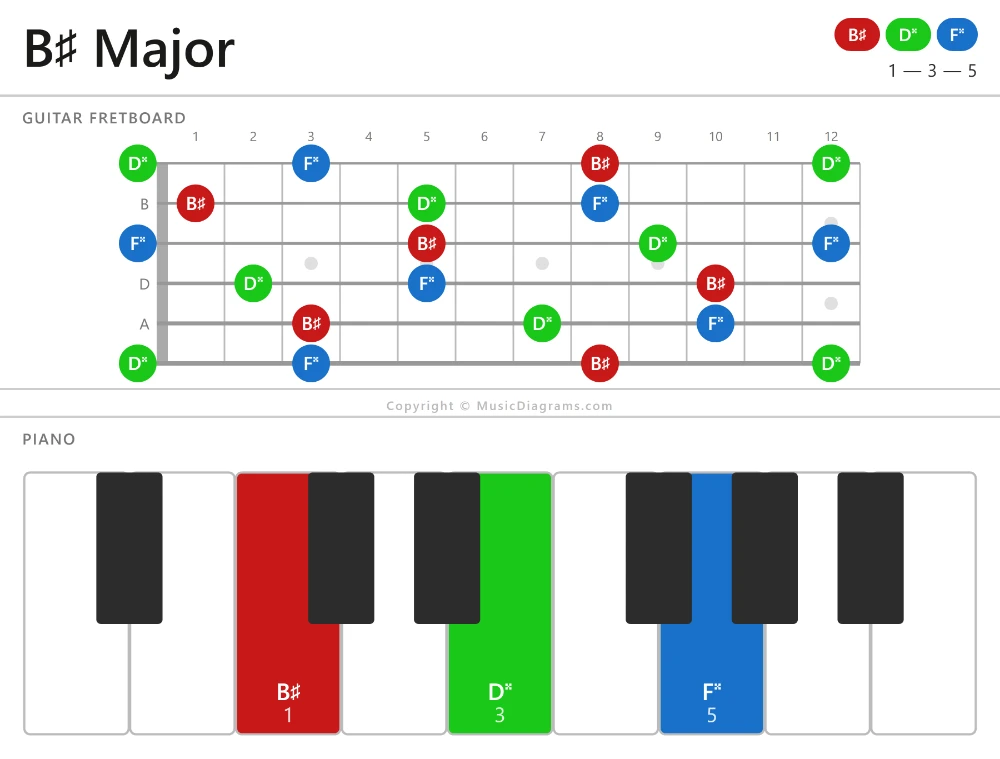
B-sharp major is a Major chord family chord built from the notes B♯, D♯♯, and F♯♯. Its root is B♯, and its interval number formula is 1–3–5, which gives you the interval names root, major third, and perfect fifth. In plain-text spelling, you may also see it written as B-sharp major, and it can be abbreviated as B♯ or B♯maj. If you are new to chords, the widget above can help you see and hear these three chord tones clearly, and learning about the chord root makes it easier to understand why B♯ is the note everything else is measured from.
B♯ Major Alternate Names
- B♯
- B♯maj
- B-sharp major
B♯ Major Chord Notes
B♯ Major Chord Formula
B♯ Major Chord Notation
How To Use B♯ Major In Music
Because a major chord usually sounds bright, stable, and confident, B♯ major has that same clear and settled quality, even though its spelling is uncommon in beginner music. It can be used as a point of rest, a strong arrival chord, or part of a progression that needs a raised spelling for theoretical accuracy. For example, it could function as I in a key center built around B♯, or appear in patterns like I–IV–V, I–vi–IV–V, or ii–V–I. Its mood can feel warmer or more triumphant when surrounded by other major chords, but it may sound more dramatic or surprising when placed after minor or diminished harmony. If you want a simple foundation first, it also helps to understand what makes a major chord sound so strong and balanced.
B♯ Major Chord Inversions
Another useful idea for beginners is inversion, which means playing the same chord with a note other than the root as the lowest note. For B♯ major, root position is B♯–D♯♯–F♯♯, first inversion is D♯♯–F♯♯–B♯, and second inversion is F♯♯–B♯–D♯♯. These inversions do not change the chord’s identity, but they do change its weight and color. Root position often sounds the most settled, first inversion can feel smoother or lighter, and second inversion can sound more open or a little less final. Musicians use inversions to create smoother bass movement, connect chords with less jumping, and shape the mood of a progression without changing the basic harmony.