The B♯ mMaj7 Chord Explained
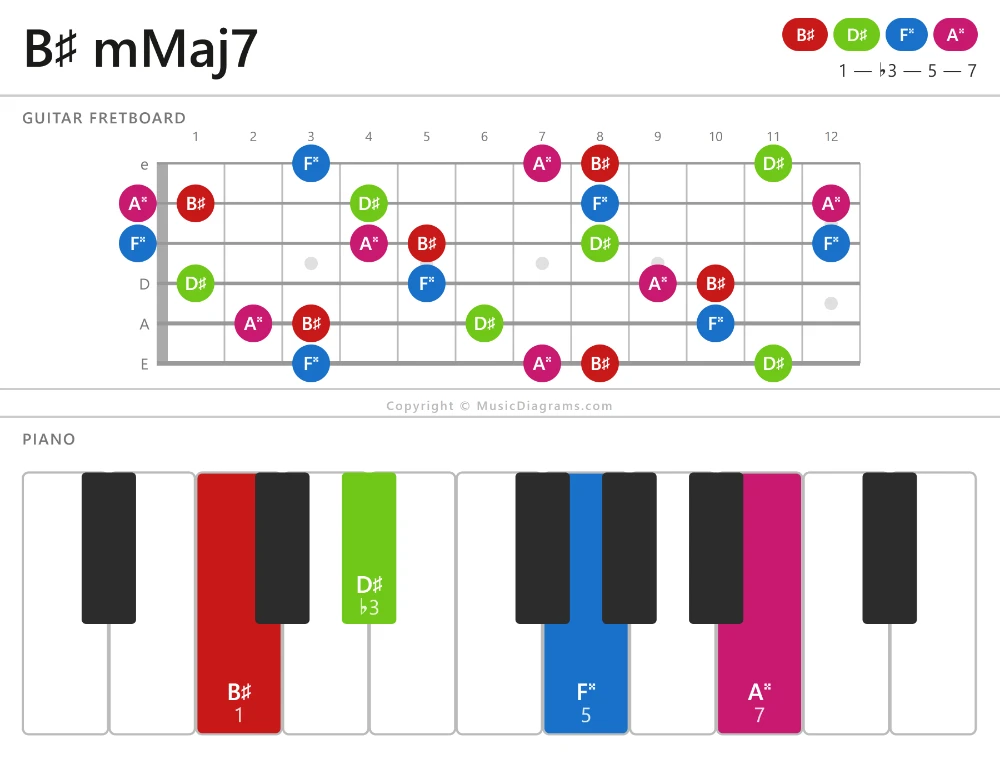
B-sharp minor major seventh is a Minor chord family chord built from the notes B♯, D♯, F♯♯, and A♯♯. Its root is B♯, which is the note the chord is named after, and you can learn more about that idea here: chord root. The interval number formula is 1-♭3-5-7, which gives you the interval names root, minor third, perfect fifth, and major seventh. This chord is also written as B♯mMaj7, B♯min(maj7), or plain-text spelled B-sharp minor major seventh. If you look at the widget above, it can help you see and hear how these four notes combine in root position.
B♯ mMaj7 Alternate Names
- B♯mMaj7
- B♯min(maj7)
- B-sharp minor major seventh
B♯ mMaj7 Chord Notes
B♯ mMaj7 Chord Formula
B♯ mMaj7 Chord Notation
How To Use B♯ mMaj7 In Music
Because of its minor triad plus a bright major seventh, this chord has a tense, mysterious, and emotionally complex sound. It can feel dramatic, dreamy, uneasy, or cinematic, and it often appears in jazz, film music, and expressive songwriting when a composer wants more color than a simple minor chord. Its effect can change depending on the chords around it: moving from i to iv can sound dark and reflective, while placing it before a dominant-style chord can increase suspense. For example, in a minor key you might hear i-iv-V-i, with B♯mMaj7 used as the i chord, or a longer motion such as i-viio7-V-i. If you want to understand why these notes create that color, this guide to chord intervals is helpful.
B♯ mMaj7 Chord Inversions
Another useful idea is inversion, which means the chord keeps the same notes but a note other than the root is the lowest pitch. For B♯ minor major seventh, root position is B♯-D♯-F♯♯-A♯♯, first inversion is D♯-F♯♯-A♯♯-B♯, second inversion is F♯♯-A♯♯-B♯-D♯, and third inversion is A♯♯-B♯-D♯-F♯♯. Inversions do not change the chord’s name family, but they do change the feel: some sound more stable, while others feel lighter, softer, or more unsettled. Musicians use inversions to make bass lines smoother, connect chords with less movement, and shape the mood of a progression more naturally. You may also see close related spellings and labels such as B♯mMaj7 or B♯min(maj7) used for the same chord quality.