The C aug Chord Explained
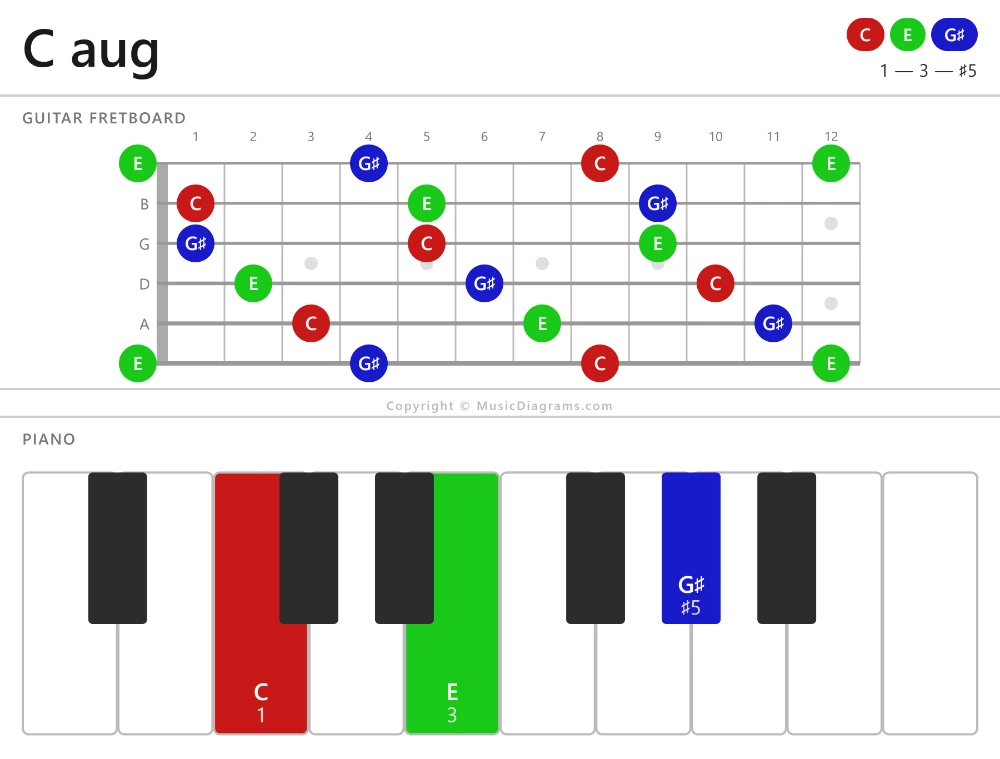
C augmented is an Augmented chord built from the notes C, E, and G♯. Its root is C, so the chord begins on C and stacks the intervals above it using the formula 1–3–♯5. In interval names, that gives you the root, major third, and augmented fifth. If you look at the widget above, you can see and hear how these three notes create a brighter and more unstable color than a regular major chord. To better understand how those distances are measured, see chord intervals. This chord may also be called C aug, C+, or plain-text spelling C augmented triad.
C aug Alternate Names
- C aug
- C+
- C augmented triad
C aug Chord Notes
C aug Chord Formula
C aug Chord Notation
How To Use C aug In Music
Because the raised fifth adds tension, C augmented often sounds bright, dramatic, dreamy, or slightly unsettled. It is commonly used as a passing chord that leads strongly into another harmony, especially when a songwriter wants movement without sounding fully dark. For example, in the key of F major, C augmented can act like V+ and resolve to F in a progression such as ii–V+–I, or Gm–C augmented–F. It may also appear in a line-moving progression like I–I+–vi, such as C–C augmented–Am. Depending on the chords around it, the same chord can feel romantic, mysterious, or urgent. If it resolves smoothly, it sounds expressive; if it lingers, it sounds more suspenseful, much like other altered dominant colors discussed in dominant chord harmony.
C aug Chord Inversions
Another useful idea is inversion, which means changing which chord note is the lowest pitch. In root position, C augmented is C–E–G♯. In first inversion, E is the lowest note, giving E–G♯–C. In second inversion, G♯ is the lowest note, giving G♯–C–E. These inversions keep the same three notes, but they can change the weight and flow of the chord. A root-position C augmented often sounds the most direct and bold, while inversions can sound smoother, softer, or more connected to nearby chords. Players use inversions to create better bass lines, reduce jumps between chords, and shape the mood of a progression more gently.