The C♭ 11 Chord Explained
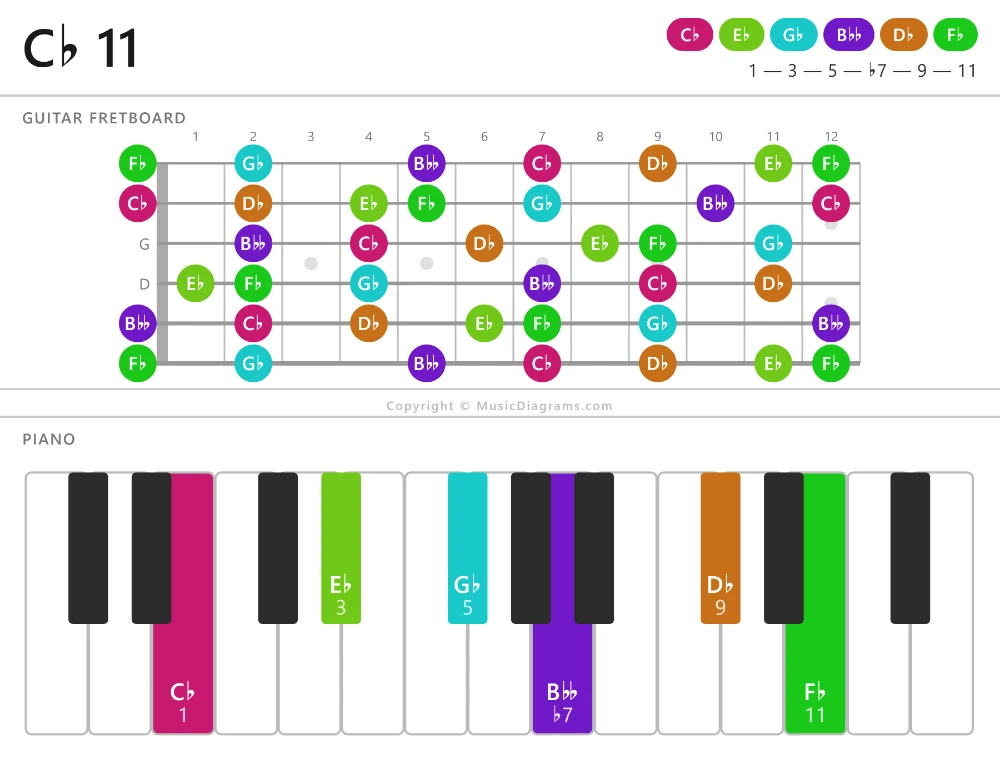
C-flat eleventh is a six-note chord from the Dominant family. It uses the notes C-flat, E-flat, G-flat, B-double-flat, D-flat, and F-flat. The root is C-flat, which is the note the chord is named after. Its interval number formula is 1–3–5–♭7–9–11, and those intervals are called root, major third, perfect fifth, minor seventh, major ninth, and perfect eleventh. You may also see it written as C-flat 11, C-flat dominant 11, or C-flat eleven. If you want to understand how these chord tones are stacked, this guide to chord intervals can help, while the widget above lets you see and hear the chord clearly.
C♭ 11 Alternate Names
- C-flat 11
- C-flat dominant 11
- C-flat eleven
C♭ 11 Chord Notes
C♭ 11 Chord Formula
C♭ 11 Chord Notation
How To Use C♭ 11 In Music
Because it contains a major triad plus a minor seventh and added color tones, this chord has a rich, tense, and spacious sound. C-flat 11 often feels unresolved, so it works well when leading toward a chord a fifth below, much like other dominant chords. In a progression, C-flat 11 might act as V moving to F-flat major or F-flat minor, or appear in a jazz-style chain such as ii–V–I. For example, D-flat minor 7 to C-flat 11 to F-flat major 7 gives a smooth ii–V–I feeling. The mood can seem warmer, darker, or more dramatic depending on the chords before and after it, especially if those surrounding chords are simple and make the extra 9th and 11th stand out more.
C♭ 11 Chord Inversions
Inversions happen when a note other than the root is placed at the bottom of the chord. For C-flat 11, that could mean E-flat in the bass for first inversion, G-flat in the bass for second inversion, or B-double-flat in the bass for another inverted sound. Players also use practical variations by leaving out some notes, especially the fifth or even the ninth, to make the chord easier to play and less crowded. These choices can change the color of the chord: root position often sounds strongest and most direct, while inversions can sound smoother, lighter, or more flowing. Musicians use inversions to create better bass movement, connect chords more smoothly, and shape the mood without changing the chord’s basic harmonic function.