The C♭ 7sus4 Chord Explained
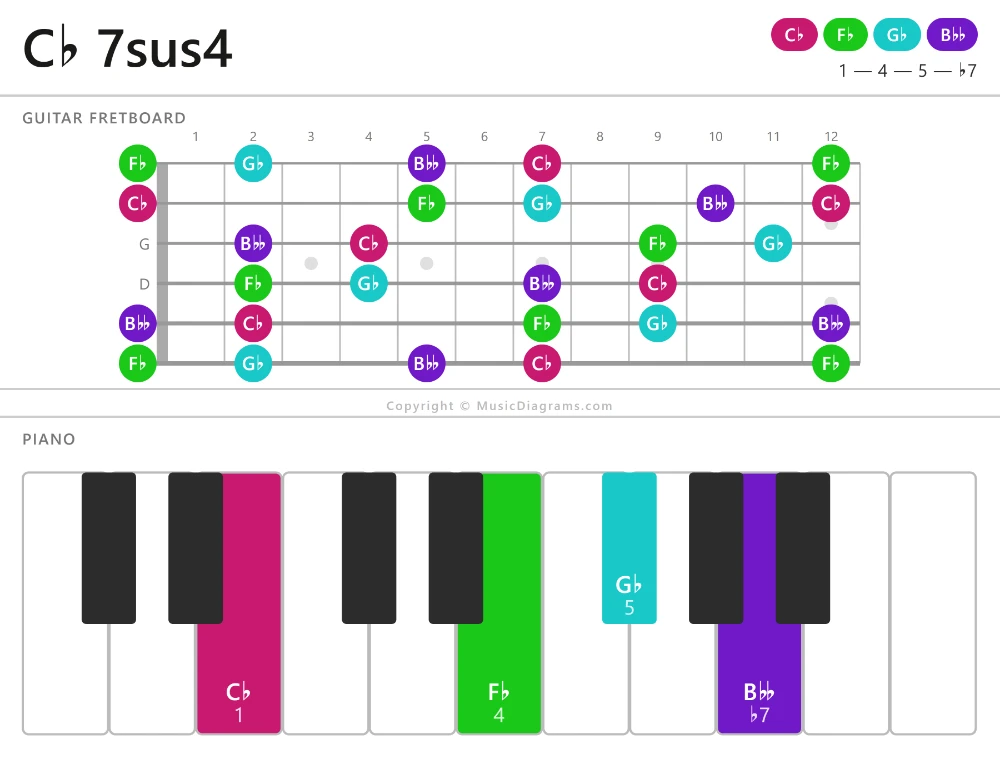
C-flat suspended fourth seventh is a Suspended chord family chord built from the notes C♭, F♭, G♭, and B♭♭. Its root is C♭, and its interval number formula is 1-4-5-♭7. Those intervals are called the root, perfect fourth, perfect fifth, and minor seventh. You may also see it written as C♭7sus4, C♭sus7, or C♭ dominant seventh suspended fourth. If you are new to chords, the widget above can help you see and hear these notes together, and learning the chord intervals makes this structure much easier to recognize.

"1-4-5 That's Sus" T-Shirt
Only True Musicians Get This. For musicians in the know. This funny 1-4-5 suspended chord pun shirt is the perfect gift for guitarists, pianists, music teachers, and music nerds.
C♭ 7sus4 Alternate Names
- C♭7sus4
- C♭sus7
- C-flat dominant seventh suspended fourth
C♭ 7sus4 Chord Notes
C♭ 7sus4 Chord Formula
C♭ 7sus4 Chord Notation
How To Use C♭ 7sus4 In Music
Because the third is replaced by a fourth, this chord sounds open, tense, and unresolved, with a strong pull toward movement. The added minor seventh gives it a bluesy, dominant color, so C♭7sus4 can work as a waiting chord before a clearer major or minor sound appears. For example, it could appear as V in a progression such as I–IV–V–I, where C♭7sus4 leads toward F♭, or in a gospel- or rock-style loop like ii–V–I. Its mood can feel stronger or softer depending on the chords around it: next to stable chords it sounds more suspended, while beside other tense chords it can sound punchy and rhythmic. If you want to understand that dominant-style pull more clearly, see what is a dominant chord.
C♭ 7sus4 Chord Inversions
Inversions happen when a note other than the root is placed in the bass. For C♭7sus4, root position has C♭ as the lowest note, while inversions place F♭, G♭, or B♭♭ in the bass. These can be described as first inversion, second inversion, and third inversion. Even though the chord tones stay the same, each inversion changes the weight and color of the sound: an F♭ in the bass can feel softer and more floating, a G♭ in the bass can sound sturdy, and a B♭♭ in the bass can increase the feeling of tension and motion. Players use inversions to make chord progressions smoother, connect bass lines more musically, and create a different mood without changing the basic identity of the chord.