The C♭ m11 Chord Explained
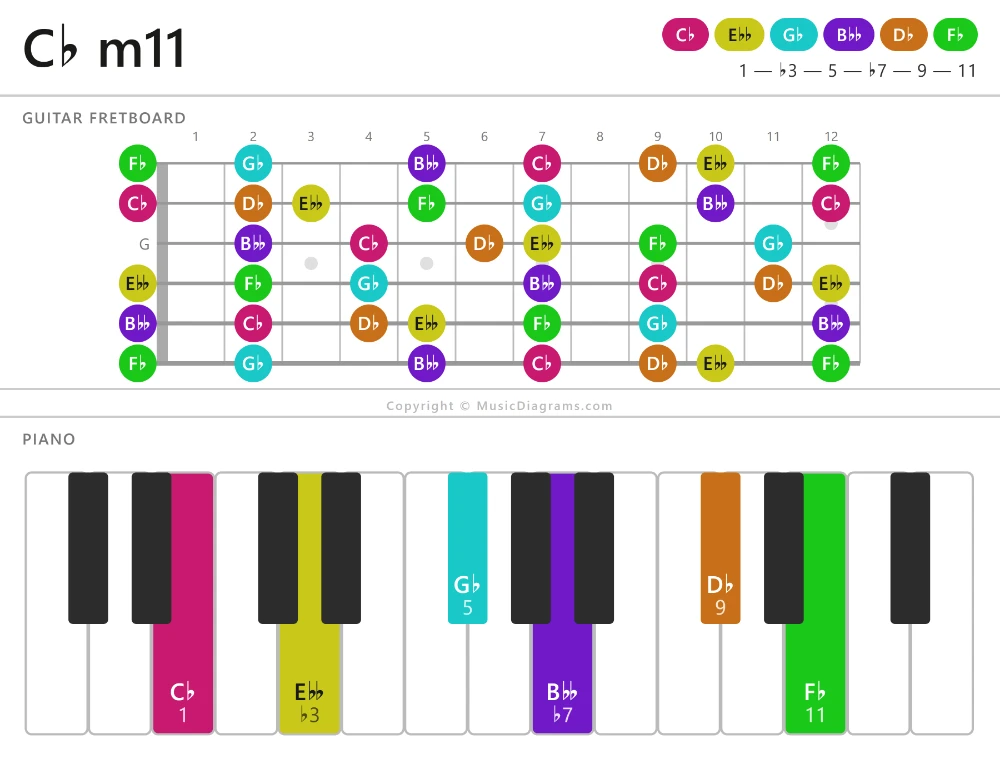
C-flat minor eleventh is a Minor chord family sound expanded into a richer color chord. Its notes are C♭, E♭♭, G♭, B♭♭, D♭, and F♭. The root is C♭, which gives the chord its name and tonal center. Its interval number formula is 1-♭3-5-♭7-9-11, and those intervals are root, minor third, perfect fifth, minor seventh, major ninth, and perfect eleventh. You may also see it written as C♭m11, C♭min11, or C♭-11. If you look at the widget above, you can use it to see and hear how these notes combine, and you can learn more about the chord root and why it matters.
C♭ m11 Alternate Names
- C♭m11
- C♭min11
- C♭-11
C♭ m11 Chord Notes
C♭ m11 Chord Formula
C♭ m11 Chord Notation
How To Use C♭ m11 In Music
Because it includes both the dark quality of a minor chord and the airy color of the 9th and 11th, this chord often sounds deep, smooth, thoughtful, and slightly jazzy. It can work well in ballads, neo-soul, jazz, film music, and atmospheric pop. On its own, C♭m11 can feel soft and reflective, but the chords around it can change that feeling a lot. For example, moving from i to iv to ♭VII can sound spacious and moody, while hearing ii–V–i in a minor key can make it feel more directional and expressive. A progression such as C♭m11–A♭m7–D♭7–G♭maj7 gives the chord a rich opening color, and in another setting it might appear as F♭maj7–C♭m11–A♭m7–G♭maj7. If you want a clearer picture of how the stacked tones are built, this guide to chord intervals is helpful.
C♭ m11 Chord Inversions
Another useful idea for beginners is inversion, which means keeping the same chord tones but placing a note other than the root at the bottom. For C♭m11, root position has C♭ as the lowest note, while an inversion could place E♭♭, G♭, B♭♭, D♭, or F♭ in the bass. These changes do not create a completely new chord quality, but they do change the weight and color of the sound. A bass note of E♭♭ can make the chord feel softer and more flowing, while G♭ or B♭♭ in the bass can make it feel more open or more suspended in motion. Musicians use inversions to create smoother bass lines, connect chords with less jumping, and shape the mood of a progression more gently. Closely related variations may also leave out one of the upper notes in performance, especially on guitar or piano, so the harmony stays clear without sounding overcrowded.