The C♭ m6/9 Chord Explained
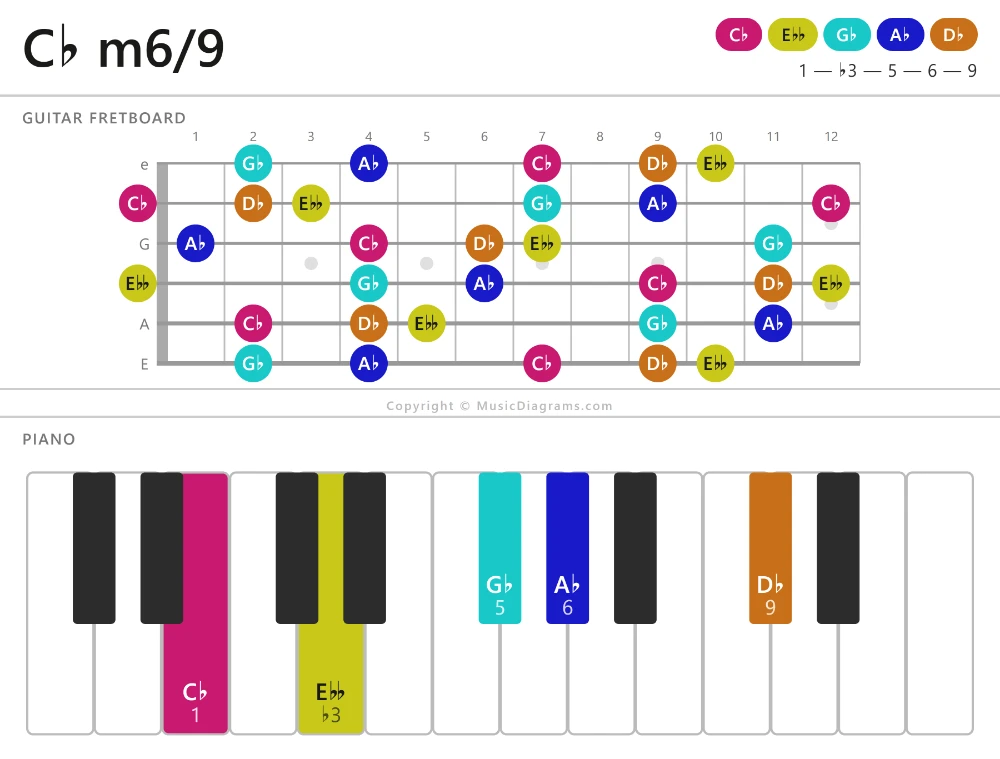
C-flat minor sixth added ninth is a Minor chord built from the notes C-flat, E-double-flat, G-flat, A-flat, and D-flat. Its root is C-flat, and its interval number formula is 1-♭3-5-6-9. Those intervals are called the root, minor third, perfect fifth, major sixth, and major ninth. You can use the chord widget above to see these notes on piano and guitar and hear how they blend together. If you are new to chord construction, learning about chord intervals can make this formula much easier to understand. This chord may also be written as C-flat m6/9, C-flat min6/9, or C-flat minor 6/9.
C♭ m6/9 Alternate Names
- C-flat m6/9
- C-flat min6/9
- C-flat minor 6/9
C♭ m6/9 Chord Notes
C♭ m6/9 Chord Formula
C♭ m6/9 Chord Notation
How To Use C♭ m6/9 In Music
Because it is a minor-based chord with added color tones, C-flat minor sixth added ninth sounds warm, gentle, and slightly jazzy rather than dark or harsh. The minor third gives it sadness, while the sixth and ninth soften that feeling and add a more open, dreamy quality. Its mood can feel richer or more tense depending on the chords around it. For example, it might appear as i in a progression like i–VI–III–VII, where C-flat minor sixth added ninth is the home chord, or it could be used as a color chord in a smoother sequence such as iv–i–♭VII. If you compare it with a basic minor chord, you will hear how the extra notes make it feel fuller and more expressive.
C♭ m6/9 Chord Inversions
Inversions happen when a note other than the root is the lowest note, even though the chord still contains the same pitch collection. With C-flat minor sixth added ninth, you might hear E-double-flat in the bass for the first inversion, G-flat in the bass for another inversion, or A-flat or D-flat in the bass for more extended voicings. These changes do not create a new chord quality, but they do change the weight and color of the sound. A root-position version feels most settled, while inversions can sound smoother, lighter, or more flowing when moving from one chord to the next. Players often use inversions to create stepwise bass lines, reduce big jumps between chords, and make progressions sound more connected.