The C maj7 Chord Explained
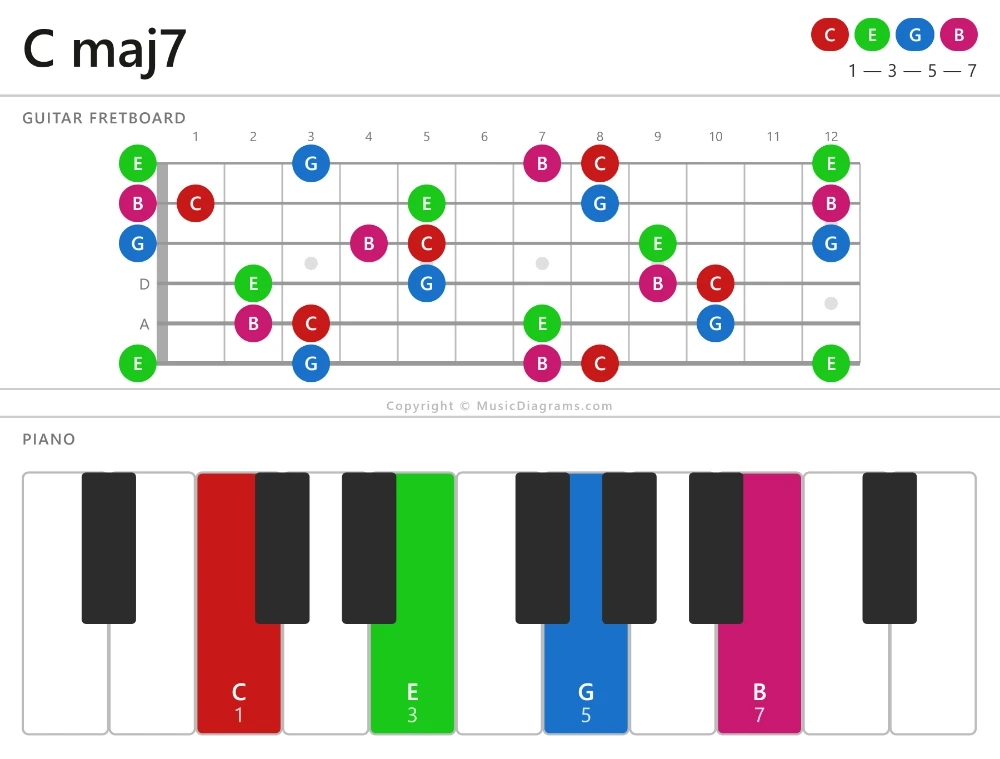
C major seventh is a Major chord family chord built from the notes C, E, G, and B. Its root is C, and its interval number formula is 1–3–5–7, which gives you the interval names root, major third, perfect fifth, and major seventh. You may also see it written as Cmaj7, CM7, or CΔ7, all meaning the same basic chord quality. If you look at the widget above, you can use the piano and guitar diagrams to visualize how these four notes combine, and the tones help you hear how each chord member relates back to the chord root.
C maj7 Alternate Names
- Cmaj7
- CM7
- CΔ7
C maj7 Chord Notes
C maj7 Chord Formula
C maj7 Chord Notation
How To Use C maj7 In Music
Often described as smooth, warm, dreamy, and slightly jazzy, C major seventh has a more colorful sound than a plain C major triad because the B adds a gentle tension against the root C. That makes it useful for jazz, pop, soul, R&B, film music, and mellow singer-songwriter progressions. For example, it might appear as I in a progression like I–vi–ii–V in C major, or as the opening chord in I–IV–iii–vi. You could also hear the chord itself as Cmaj7 moving to Am7, Dm7, or G7, where the surrounding harmony can make it feel more settled, more wistful, or more sophisticated. If you want to better understand why its notes sound so stable yet colorful together, it helps to study chord intervals.
C maj7 Chord Inversions
Inversions happen when a note other than the root is placed at the bottom of the chord. For C major seventh, root position is C–E–G–B, while the inversions are first inversion E–G–B–C, second inversion G–B–C–E, and third inversion B–C–E–G. These versions still contain the same four notes, but they change the balance and feeling of the chord. A first inversion can sound lighter and less final, a second inversion can feel more open, and a third inversion often sounds more delicate or unstable because the major seventh is in the bass. Players use inversions to create smoother bass movement, connect chords with less jumping, and shape the mood of a progression without changing the chord’s core identity.