The C♯ m11 Chord Explained
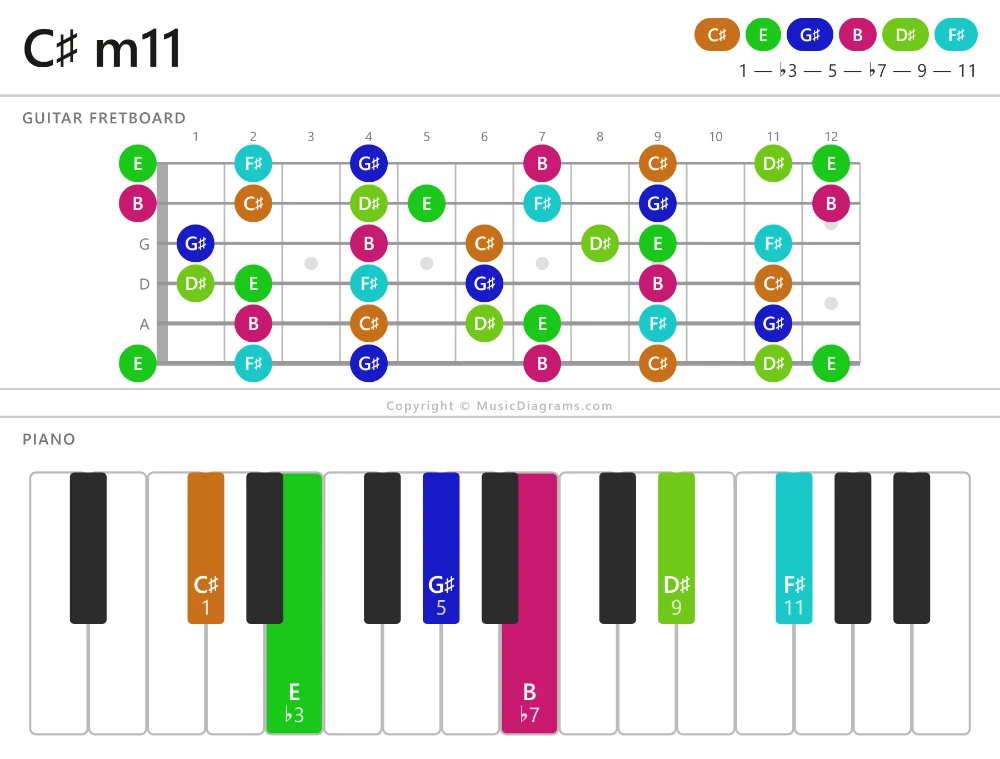
C-sharp minor eleventh is a Minor chord family sonority built from the notes C♯, E, G♯, B, D♯, and F♯. Its root is C♯, and its interval number formula is 1-♭3-5-♭7-9-11. In interval names, that gives you root, minor third, perfect fifth, minor seventh, major ninth, and perfect eleventh. You may also see it written as C♯m11, C♯min11, or C♯-11, all meaning the same basic chord color. If you look at the widget above, you can use the piano or guitar diagram to spot each chord tone and hear how these stacked notes create a rich minor sound. If you are new to chord structure, this quick guide to chord intervals can help make the formula easier to understand.
C♯ m11 Alternate Names
- C♯m11
- C♯min11
- C♯-11
C♯ m11 Chord Notes
C♯ m11 Chord Formula
C♯ m11 Chord Notation
How To Use C♯ m11 In Music
Because C♯m11 includes both the darker minor quality and the airy color of the 9th and 11th, it often sounds smooth, expressive, jazzy, and a little reflective. Beginners often hear it as more spacious than a plain minor chord, since the extra notes add depth without making it sound harsh. The mood can shift depending on the chords around it: next to brighter chords it can feel wistful, while in a darker progression it can feel moody or cinematic. For example, in the key of B major, C♯m11 can act as ii in a ii–V–I progression such as C♯m11–F♯7–Bmaj7. In A major, it might appear as iii in I–iii–IV–V, such as A–C♯m11–D–E. It can also work well in modern pop, R&B, soul, and jazz when a songwriter wants a softer minor color than a basic triad. To compare that core sound with a simpler version, see this explanation of what is a minor chord.
C♯ m11 Chord Inversions
Another useful idea for beginners is inversion, which means playing the same chord with a note other than the root at the bottom. In root position, C♯ is the lowest note, but you can also use first inversion with E in the bass, second inversion with G♯ in the bass, third inversion with B in the bass, or even extended-note bass shapes such as D♯ or F♯ in the bass when arranging the full C♯m11 sound. These choices do not change the chord’s name in a basic harmonic sense, but they do change its weight, smoothness, and direction. A C♯m11/E can sound gentler and less settled, while C♯m11/B can emphasize the seventh and create more pull into the next chord. Players use inversions to make bass lines smoother, connect chords with less jumping, and shape the emotional flow of a progression.