The C♯ m7♭9 Chord Explained
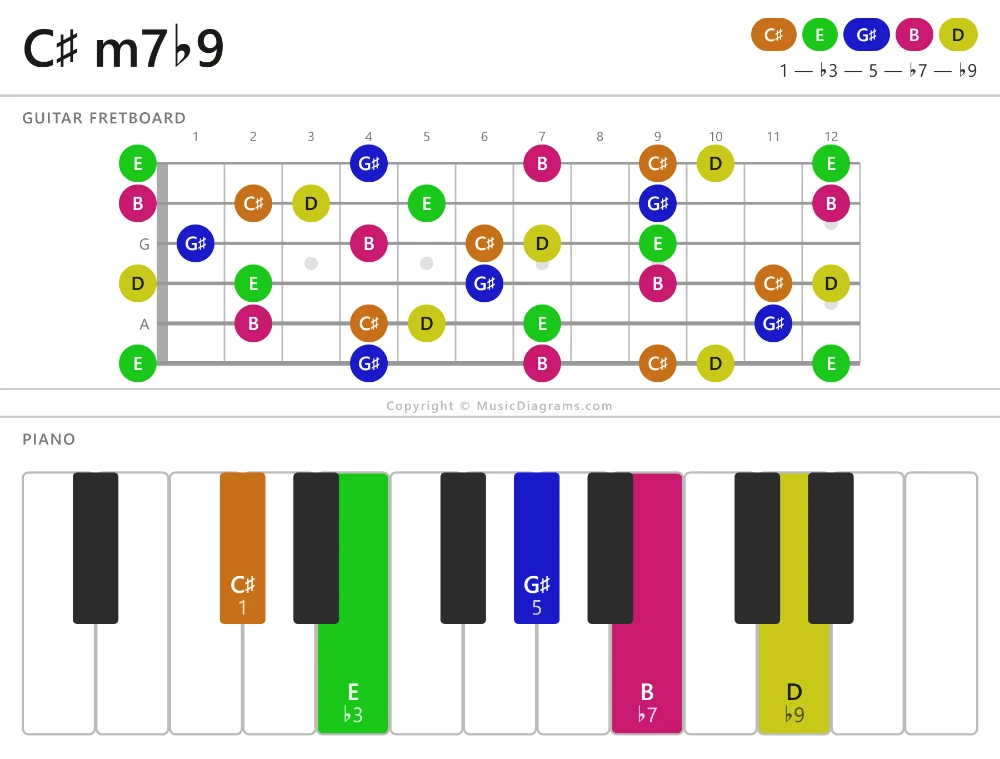
C-sharp minor seventh flat ninth is a Minor chord family chord with an added flat ninth color, built from the notes C♯, E, G♯, B, and D. Its root is C♯, and its interval number formula is 1–♭3–5–♭7–♭9. These intervals are called the root, minor third, perfect fifth, minor seventh, and minor ninth. You may also see this chord written as C♯m7♭9, C♯min7♭9, or C♯-7♭9. If you look at the widget above, you can use it to see and hear how these notes stack together, and it can also help to learn more about the chord intervals that give this chord its sound.
C♯ m7♭9 Alternate Names
- C♯m7♭9
- C♯min7♭9
- C♯-7♭9
C♯ m7♭9 Chord Notes
C♯ m7♭9 Chord Formula
C♯ m7♭9 Chord Notation
How To Use C♯ m7♭9 In Music
Because of its minor seventh base and tense flat ninth, this chord sounds dark, moody, jazzy, and slightly unstable. It can create suspense, emotional depth, or a dramatic pull toward another chord. On its own, C♯m7♭9 can feel mysterious, but the chords around it strongly shape its effect: moving to a stable tonic can make it sound like a buildup, while surrounding it with other tense chords can make the harmony feel even more unsettled. For example, in a progression like i–iv–i, C♯m7♭9 can act as the tonic color chord in C♯ minor; in a darker sequence such as i–VI–III–VII, the C♯m7♭9 chord adds extra tension at the start; and in jazz-influenced writing, it may appear as a color-rich minor sonority before a dominant chord, such as i–iv–V. If you want to compare that pull with a brighter, more directional harmony, see how a dominant chord works.
C♯ m7♭9 Chord Inversions
Another useful idea is inversion, which means changing which note is the lowest note while keeping the same chord tones. In root position, C♯ is the lowest note. Inversions of C♯m7♭9 could place E, G♯, B, or D in the bass instead, giving you different bass colors such as C♯m7♭9/E, C♯m7♭9/G♯, C♯m7♭9/B, or C♯m7♭9/D. These versions do not change the chord’s basic identity, but they can change how smooth, tense, heavy, or floating it feels. For beginners, inversions are often used to make chord progressions easier to connect, to create a stepwise bass line, or to spotlight a certain note in the harmony. A bass note like E can make the chord feel a little softer, while D in the bass can emphasize the dissonant flat ninth sound more strongly.