The D♭ 11 Chord Explained
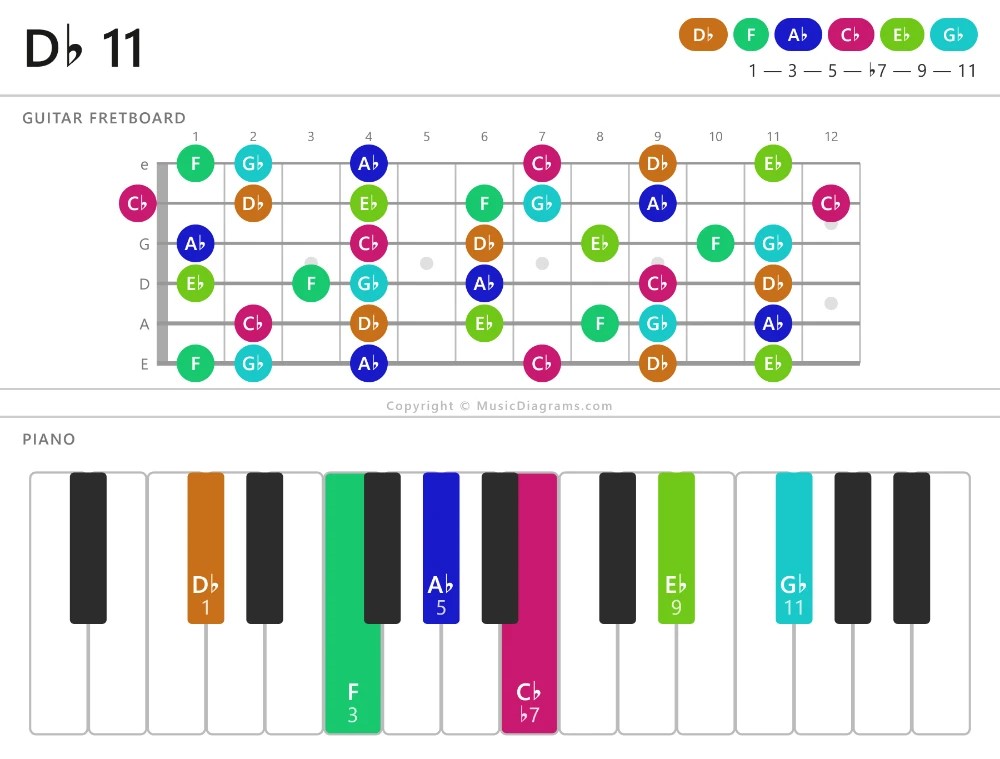
D-flat eleven is an extended chord in the Dominant family. It uses the notes D-flat, F, A-flat, C-flat, E-flat, and G-flat. The root is D-flat, and its interval number formula is 1–3–5–♭7–9–11. Those intervals are called the root, major third, perfect fifth, minor seventh, major ninth, and perfect eleventh. You may also see this chord written as D♭11, Db11, or D-flat dominant eleven. If you look at the widget above, you can see and hear how these notes stack together; this can make it easier to connect the shape and sound. To learn more about how these chord tones are built, see understanding chord intervals.
D♭ 11 Alternate Names
- D♭11
- Db11
- D-flat dominant eleven
D♭ 11 Chord Notes
D♭ 11 Chord Formula
D♭ 11 Chord Notation
How To Use D♭ 11 In Music
Because it includes both a strong dominant seventh sound and added color tones, D-flat eleven sounds rich, tense, and jazzy, with a spacious quality from the 11th. It often creates a feeling that wants to move forward, usually toward a chord built a fifth below, so it commonly resolves like a dominant chord. For example, in G-flat major, D-flat11 can function as V moving to I in a progression like ii–V–I, or A-flat minor–D-flat11–G-flat major. In B major, the same chord can be heard as a colorful borrowed sonority in a chain such as ♭III–♭VI–♭II–I depending on the surrounding harmony. The mood can feel brighter, darker, smoother, or more dramatic based on the chords before and after it. If the harmony around it is new to you, reading about what a dominant chord is can help you hear why this chord pulls so strongly.
D♭ 11 Chord Inversions
Another useful idea is inversion, which means playing the same chord with a note other than D-flat at the bottom. For D-flat eleven, you might see first inversion with F in the bass, second inversion with A-flat in the bass, or third inversion with C-flat in the bass. Players may also use lighter variations such as leaving out the 5th, or sometimes spacing the notes farther apart so the chord sounds clearer. Inversions can make the chord feel smoother, softer, more grounded, or more unsettled depending on which note is lowest. They are often used to create better bass movement, connect chords more easily, and reduce large jumps in accompaniment parts.