The D♭ m7 Chord Explained
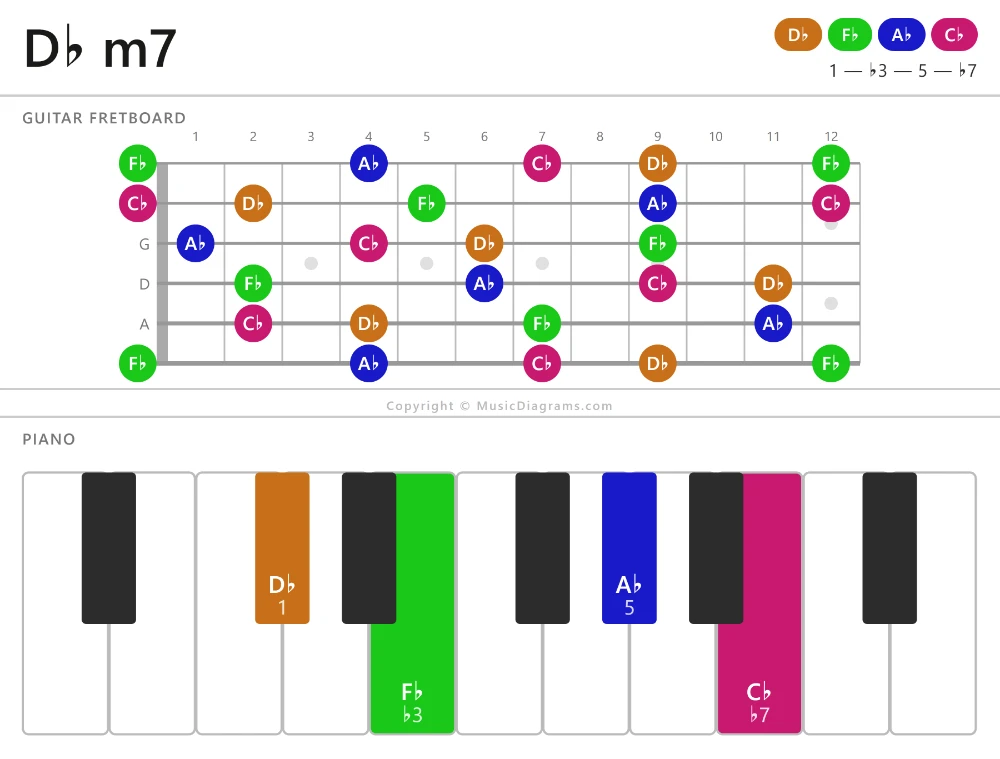
D-flat minor seventh is a Minor chord family chord built from the notes D-flat, F-flat, A-flat, and C-flat. Its root is D-flat, and its interval number formula is 1-♭3-5-♭7, which gives you the interval names root, minor third, perfect fifth, and minor seventh. You may also see it written as D♭m7, D-flat min7, or D-flat minor 7. If you look at the widget above, you can match these four notes on the piano and guitar diagrams and hear how they combine into one chord. To better understand why these notes work together, see chord intervals.
D♭ m7 Alternate Names
- D♭m7
- D-flat min7
- D-flat minor 7
D♭ m7 Chord Notes
D♭ m7 Chord Formula
D♭ m7 Chord Notation
How To Use D♭ m7 In Music
Because D-flat minor seventh includes both the darker color of a minor chord and the added softness of a minor seventh, it tends to sound smooth, mellow, reflective, and slightly jazzy rather than harsh. Beginners often hear it as more emotional and open than a plain minor triad. In progressions, it can work as a tonic-style color chord, a passing chord, or part of richer harmony in jazz, soul, R&B, and pop. For example, in the key of D-flat minor, D♭m7 can function as i7 in a progression like i7–VI–III–VII, or it may appear in a jazz-inspired move such as ii–V–i when paired with surrounding chords that increase tension and release. The chords around it matter a lot: next to brighter major chords it can feel sadder, while next to darker minor or diminished chords it can sound warm and settled. If you want a quick comparison with its simpler base quality, read about what is a minor chord.
D♭ m7 Chord Inversions
Another useful idea is inversion, which means the chord still contains the same notes but a note other than the root is placed on the bottom. For D-flat minor seventh in root position, the notes are D-flat, F-flat, A-flat, C-flat. Its 1st inversion is F-flat, A-flat, C-flat, D-flat; its 2nd inversion is A-flat, C-flat, D-flat, F-flat; and its 3rd inversion is C-flat, D-flat, F-flat, A-flat. These inversions do not change the chord’s name quality, but they do change the weight and color of the sound. A root-position shape often feels most stable, while inversions can sound smoother, lighter, or more flowing, especially when moving from one chord to the next. Musicians use inversions to create better voice leading, reduce large jumps between bass notes, and give a progression a more polished sound.