The D♭ maj9 Chord Explained
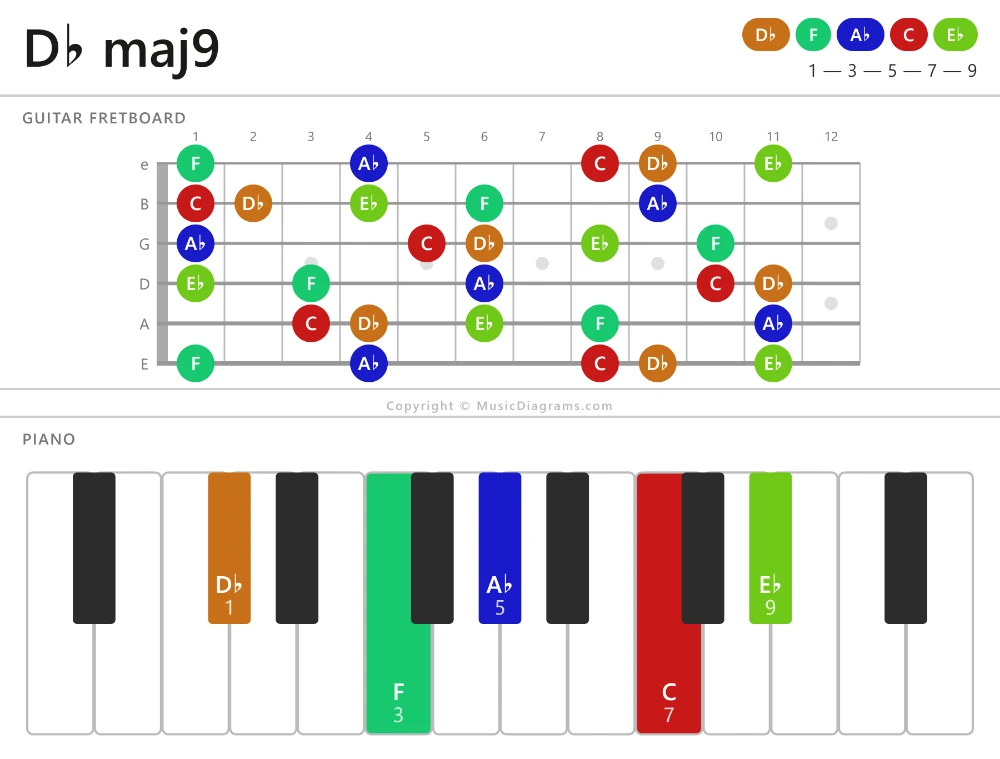
D-flat major ninth is a Major chord family color chord built from the notes D♭, F, A♭, C, and E♭. Its root is D♭, and its interval number formula is 1–3–5–7–9, which gives you the interval names root, major third, perfect fifth, major seventh, and major ninth. You may also see it written as D♭maj9, D♭M9, or D♭Δ9. If you look at the widget above, you can see and hear how these five notes combine into one rich, smooth sound, and you can learn more about how these distances work in chord intervals.
D♭ maj9 Alternate Names
- D♭maj9
- D♭M9
- D♭Δ9
D♭ maj9 Chord Notes
D♭ maj9 Chord Formula
D♭ maj9 Chord Notation
How To Use D♭ maj9 In Music
Because of its major seventh and added ninth, this chord sounds warm, polished, and dreamy rather than simple or plain. It often appears in jazz, soul, R&B, pop ballads, and cinematic music when a songwriter wants a lush resting point or a gentle moment of color. For example, in the key of D♭ major, D♭maj9 can act as I in a progression like I–vi–ii–V, or it may follow IV and lead back home in a move such as IV–V–I. Its mood can feel more peaceful when surrounded by other major-family chords, but it can also sound more emotional after minor chords or more resolved after a dominant chord.
D♭ maj9 Chord Inversions
Another useful idea is inversion, which means the chord keeps the same notes but starts on a note other than the root. For D♭maj9, a first inversion would place F in the bass, a second inversion would place A♭ in the bass, a third inversion would place C in the bass, and a fourth inversion would place E♭ in the bass. These inversions do not change the chord’s name quality, but they do change the weight and flow of the sound. A root-position D♭maj9 often feels settled and complete, while inversions can sound lighter, smoother, or more directional, which is why players use them to connect chords neatly and create a more singing bass line. You may also hear close and wide voicings of D♭maj9, where the same chord tones are arranged more tightly or more spread out for a softer or more spacious effect.