The D m7♭9 Chord Explained
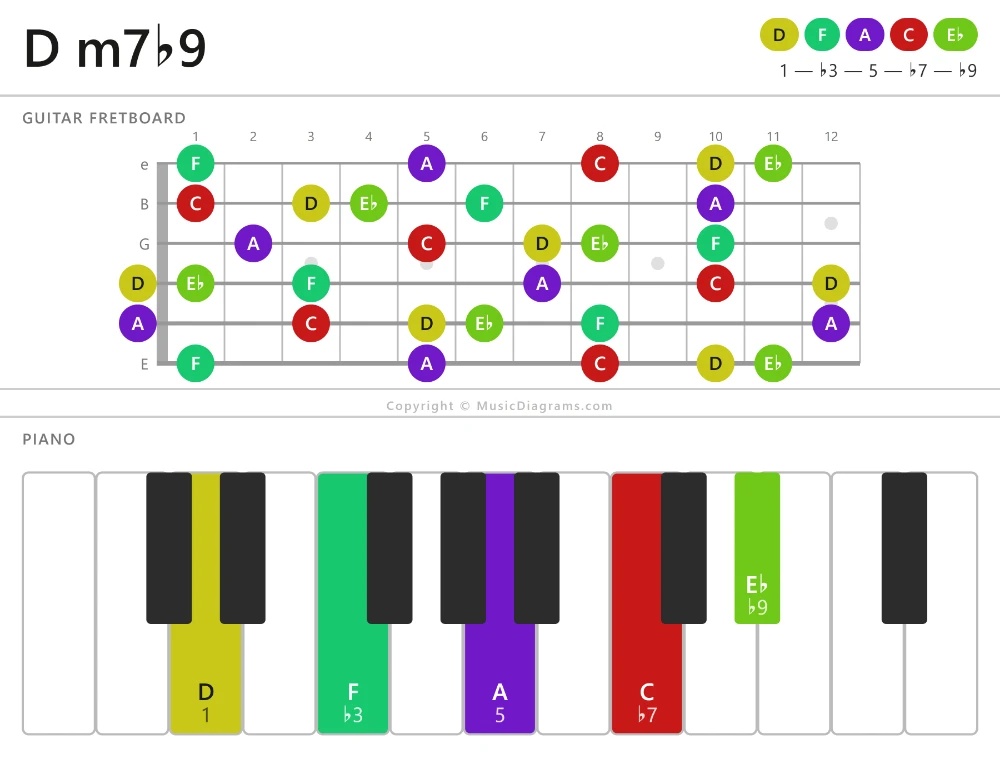
D minor seventh flat ninth is a Minor chord family color chord built from the notes D, F, A, C, and E-flat. Its root is D, and its interval number formula is 1-♭3-5-♭7-♭9. Those intervals are called the root, minor third, perfect fifth, minor seventh, and flat ninth. You may also see it written as Dm7♭9, Dmin7♭9, or D-7♭9. If you are new to chords, the widget above can help you see and hear how these notes stack together, and learning about chord intervals makes this structure much easier to understand.
D m7♭9 Alternate Names
- Dm7♭9
- Dmin7♭9
- D-7♭9
D m7♭9 Chord Notes
D m7♭9 Chord Formula
D m7♭9 Chord Notation
How To Use D m7♭9 In Music
Because of its minor core plus the tense E-flat, this chord sounds dark, expressive, and unsettled. It can create sadness, suspense, or a dramatic pull toward the next harmony. In songs, Dm7♭9 often works as a colorful minor chord in jazz, film music, and more emotional styles, especially when it resolves smoothly into a more stable chord. For example, in a progression like i-iv-i, the chord could appear as i in D minor, or in a jazz-style motion such as ii-V-i in C minor, where Dm7♭9 adds extra tension before the harmony moves on. The chords around it strongly affect its mood: placed near gentle minor chords it can feel mournful, while next to sharper dissonant chords it can sound even more urgent. If you want to compare its tension with a stronger unstable sound, see how a diminished chord works.
D m7♭9 Chord Inversions
Another useful idea is inversion, which means the chord keeps the same notes but starts from a note other than D. In root position, D is the lowest note; in first inversion, F is lowest; in second inversion, A is lowest; in third inversion, C is lowest; and in a further voicing, E-flat can be placed in the bass. These different bass notes can change the feeling without changing the chord’s identity. A Dm7♭9 with F in the bass may sound softer and more inward, while one with C or E-flat in the bass can sound more unstable or dramatic. Musicians use inversions to make bass lines smoother, connect chords more gracefully, and shape the mood of a progression with less jumping between notes.