The D maj9 Chord Explained
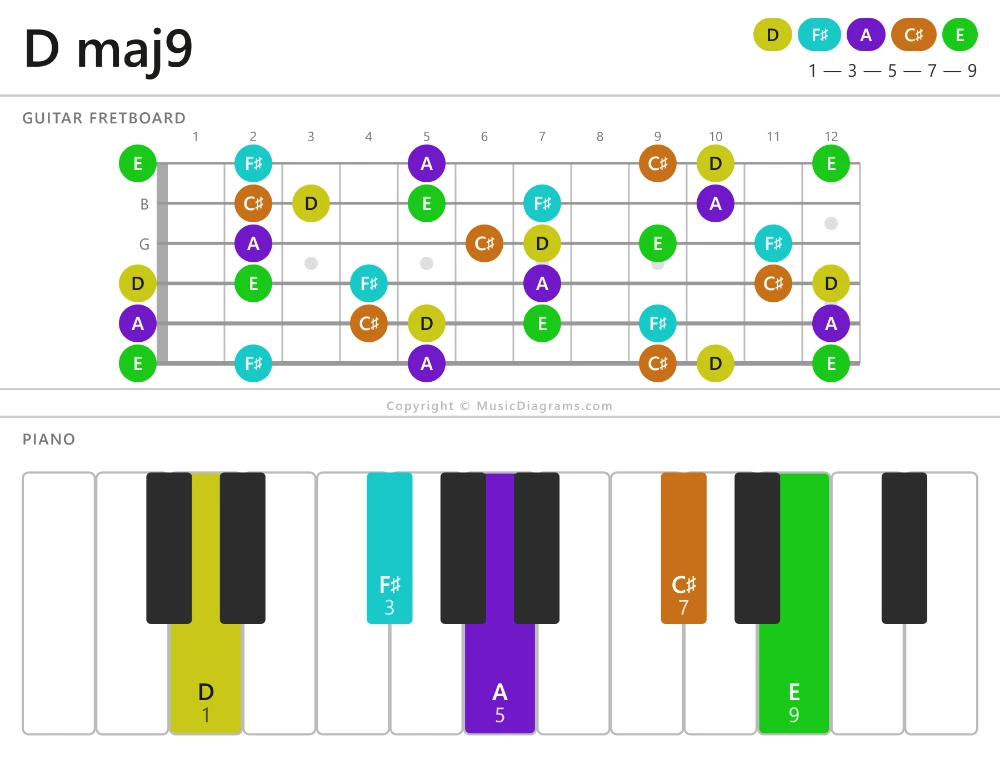
D major ninth is a Major chord family color chord built from the notes D, F♯, A, C♯, and E. Its root is D, and its interval number formula is 1–3–5–7–9, which gives you the interval names root, major third, perfect fifth, major seventh, and major ninth. You may also see it written as Dmaj9, DM9, or D major 9. If you look at the widget above, you can visualize how these chord tones stack together, and if you want to learn more about how those tones are measured, this guide to chord intervals is a helpful next step.
D maj9 Alternate Names
- Dmaj9
- DM9
- D major 9
D maj9 Chord Notes
D maj9 Chord Formula
D maj9 Chord Notation
How To Use D maj9 In Music
Because of its major seventh and added ninth, D major ninth has a smooth, open, and polished sound that often feels warm, dreamy, and sophisticated. Beginners often hear it as richer than a plain D major chord, but still stable and bright. It works well in pop, jazz, soul, R&B, film music, and softer rock, especially when you want a lush resting point or a colorful tonic sound. For example, in the key of D major it can appear as I with Dmaj9 in a progression like I–vi–ii–V, or it may follow a stronger setup such as ii–V–I where Dmaj9 is the arrival chord. The mood can shift depending on the surrounding harmony: after a tense dominant chord it feels especially calm, while next to other extended chords it sounds even more elegant. For extra background, you can compare that tension-and-release role with a dominant chord.
D maj9 Chord Inversions
Another useful idea is inversion, which means the chord still contains the same notes, but a note other than the root is placed in the bass. For D major ninth, root position has D as the lowest note, while inversions could place F♯, A, C♯, or E in the bass. These choices do not change the chord’s name family, but they do change its feel: F♯ in the bass can sound smoother and more connected, A in the bass can feel more grounded and spacious, and C♯ or E in the bass can sound more floating or modern. Musicians use inversions to make bass lines move more stepwise, connect chords more smoothly, or create a different emotional color without changing the basic harmony. Variations related to this chord can also include simpler forms like Dmaj7 or fuller textures voiced across different octaves, all while keeping that clearly major, glossy character.