The D♯ 7 Chord Explained
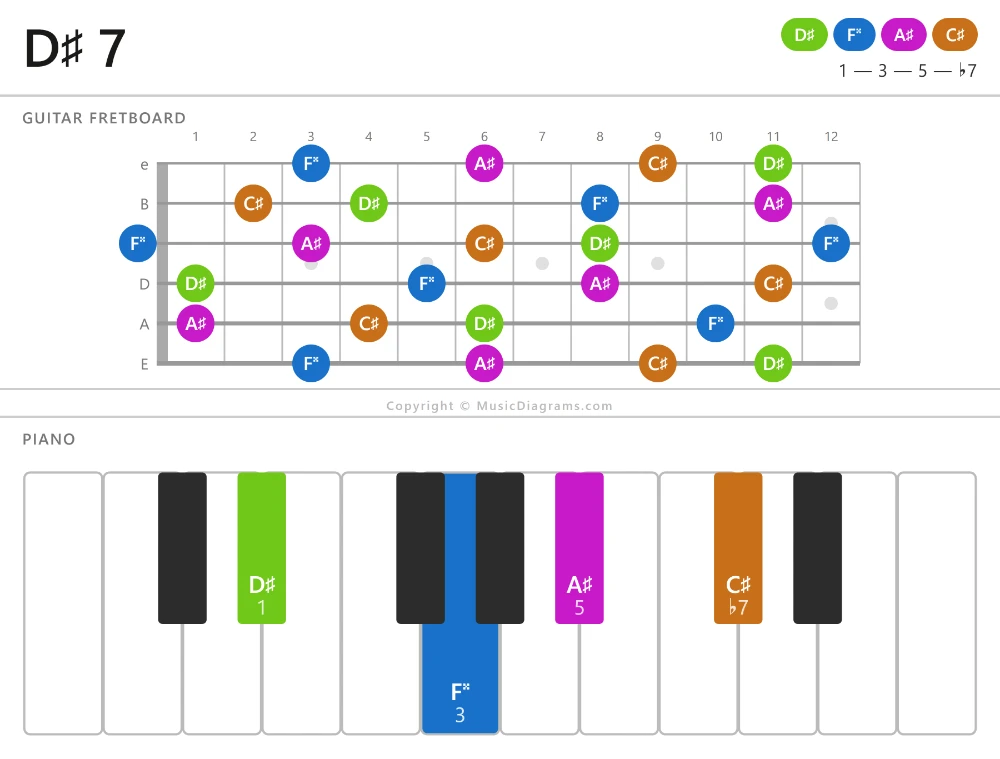
D-sharp dominant seventh is a Dominant chord built from the notes D♯, F♯♯, A♯, and C♯. Its root is D♯, and its interval number formula is 1–3–5–♭7, which gives you the interval names root, major third, perfect fifth, and minor seventh. You may also see it called D♯7, D-sharp 7, or D-sharp dominant 7. If you look at the widget above, you can see and hear how these four notes combine to form this bright, tense sound, and you can learn more about how these building blocks work in chord intervals.
D♯ 7 Alternate Names
- D♯7
- D-sharp 7
- D-sharp dominant 7
D♯ 7 Chord Notes
D♯ 7 Chord Formula
D♯ 7 Chord Notation
How To Use D♯ 7 In Music
Because a dominant seventh chord naturally wants to resolve, D♯7 sounds bright, strong, and full of tension that pushes the music forward. It often creates a feeling of expectation, which makes it useful before a more stable chord. For example, in the key of G♯ major, D♯7 works as the V7 chord leading to G♯ major in a ii–V7–I progression such as A♯ minor–D♯7–G♯ major. In blues, jazz, pop, and musical theater, it can also be used for color and movement, and the mood can feel smoother, sharper, or more dramatic depending on the chords around it. If you want a deeper look at this chord type, read what is a dominant chord.
D♯ 7 Chord Inversions
Another useful idea is inversion, which means the chord keeps the same notes but a different note is placed at the bottom. For D♯7 in root position, D♯ is the lowest note, while the inversions are first inversion with F♯♯ in the bass, second inversion with A♯ in the bass, and third inversion with C♯ in the bass. These versions can sound less final, more flowing, or more connected to nearby chords, which is why musicians use them to make chord progressions smoother. You may also hear close voicings or wider spacings of D♯7, and although the chord quality stays the same, the balance and mood can feel tighter, warmer, or more open.