The D♯ 9 Chord Explained
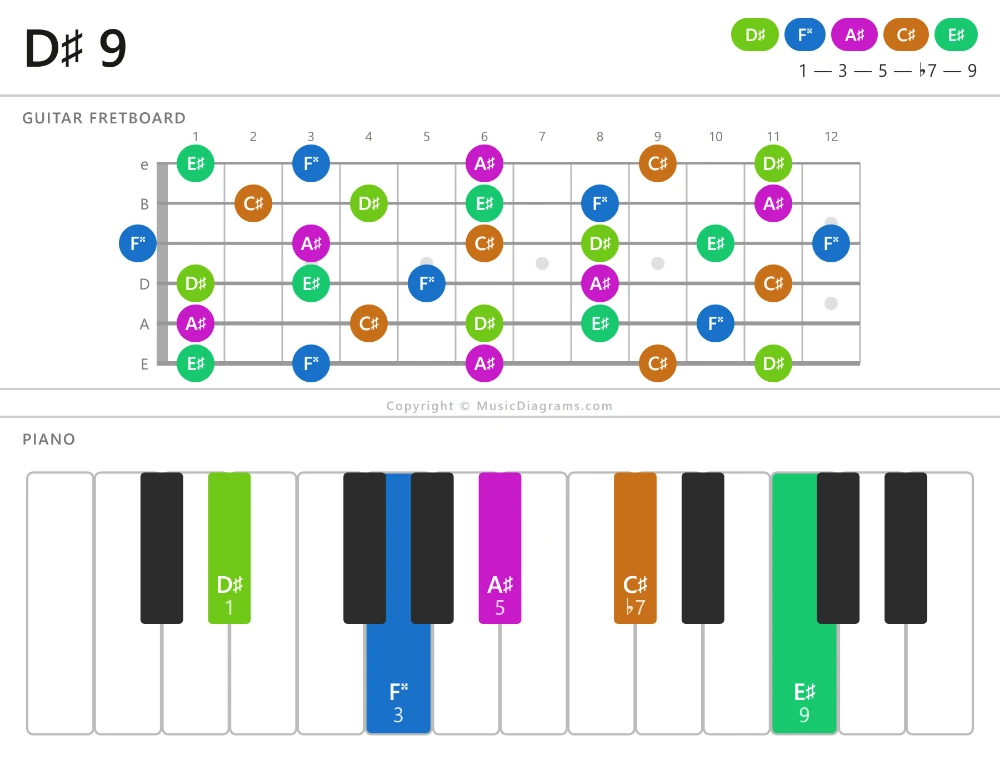
D-sharp ninth is a Dominant chord made of the notes D♯, F♯♯, A♯, C♯, and E♯. Its root is D♯, and its interval number formula is 1–3–5–♭7–9, which gives you the interval names root, major third, perfect fifth, minor seventh, and major ninth. You may also see it written as D♯9, D-sharp 9, or D-sharp dominant ninth. If you look at the widget above, you can use it to see these chord tones laid out clearly and hear how they combine; this is especially helpful when learning how each note relates back to the chord root.
D♯ 9 Alternate Names
- D♯9
- D-sharp 9
- D-sharp dominant ninth
D♯ 9 Chord Notes
D♯ 9 Chord Formula
D♯ 9 Chord Notation
How To Use D♯ 9 In Music
Because it contains both a strong major triad and a tense minor seventh with an added ninth, this chord has a bright but restless sound that wants to move forward. It often creates excitement, color, and pull, which is why it appears so often before a resolution. In many songs, D♯9 can function like a dominant chord leading to a chord a fourth above, and the mood it creates can feel sharper, bluesier, or smoother depending on the chords around it. For example, in a jazz-style turnaround you might hear ii–V–I, where V is D♯9; in longer motion, something like iii–vi–V–I can also feature D♯9 as the dominant push. If you want to understand why this chord feels so active, it helps to learn more about dominant chords.
D♯ 9 Chord Inversions
Another useful idea is inversion, which means keeping the same notes but putting a note other than D♯ at the bottom. For D♯9, examples include first inversion with F♯♯ in the bass, second inversion with A♯ in the bass, third inversion with C♯ in the bass, and an inversion with E♯ in the bass. These versions can sound smoother, lighter, or more unsettled than root position, even though the chord quality stays the same. Players use inversions to connect chords with less jumping between bass notes, to create a more flowing accompaniment, or to highlight a different color inside the chord. You may also hear close voicings or wider voicings of D♯9, which can make the chord feel tighter and punchier or more open and spacious.