The D♯ m6/9 Chord Explained
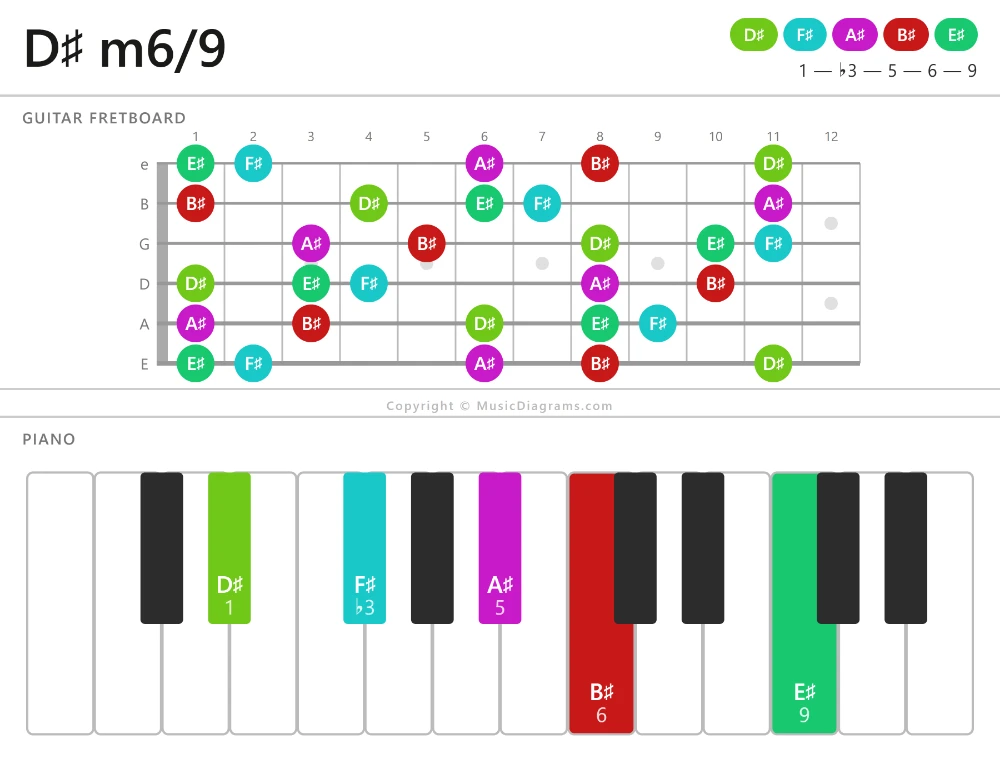
D-sharp minor sixth add ninth is a Minor chord family sound built from the notes D♯, F♯, A♯, B♯, and E♯. Its root is D♯, which is the note the chord is named after, and you can learn more about that in this guide to chord roots. The interval number formula is 1-♭3-5-6-9, which gives you the interval names root, minor third, perfect fifth, major sixth, and major ninth. In plain-text spelling, this chord may also be called D-sharp minor 6 add 9, and common symbols include D♯m6/9 and D♯min6/9. If you look at the widget above, you can use the fretboard and piano diagram to see exactly where these chord tones sit.
D♯ m6/9 Alternate Names
- D-sharp minor sixth add ninth
- D♯m6/9
- D♯min6/9
D♯ m6/9 Chord Notes
D♯ m6/9 Chord Formula
D♯ m6/9 Chord Notation
How To Use D♯ m6/9 In Music
Because it combines the sadness of a minor chord with the warmth of a sixth and the color of a ninth, D♯ m6/9 often sounds gentle, jazzy, dreamy, or reflective rather than dark and heavy. The notes B♯ and E♯ add extra softness and richness, so the chord can work well in ballads, neo-soul, jazz, film music, and mellow pop. Its mood can shift depending on the chords around it: for example, moving from i to iv or VI can feel intimate, while placing D♯m6/9 as i in a progression like i–VI–III–VII gives a smooth, emotional color. It may also appear in more colorful minor-key progressions such as VI–i–iv–V or iv–i–VII–III. If you are new to chord building, understanding chord intervals will help explain why this chord feels more colorful than a basic minor triad.
D♯ m6/9 Chord Inversions
Another useful idea is inversion, which means the chord keeps the same notes but a different note is placed in the bass. For D♯ m6/9, root position has D♯ as the lowest note, while inversions might place F♯, A♯, B♯, or E♯ in the bass. A voicing with F♯ in the bass can sound smoother and less final, while A♯ in the bass can give the chord more lift. Using B♯ or E♯ in the bass can make the chord feel especially floating or modern. Players use inversions to create stepwise bass lines, connect chords more smoothly, and change the mood without changing the basic chord quality. Closely related variations can also appear in music, such as D♯m6, D♯madd9, or a simpler D♯ minor triad, each keeping some of the same character but with less harmonic color.