The D♯ sus2 Chord Explained
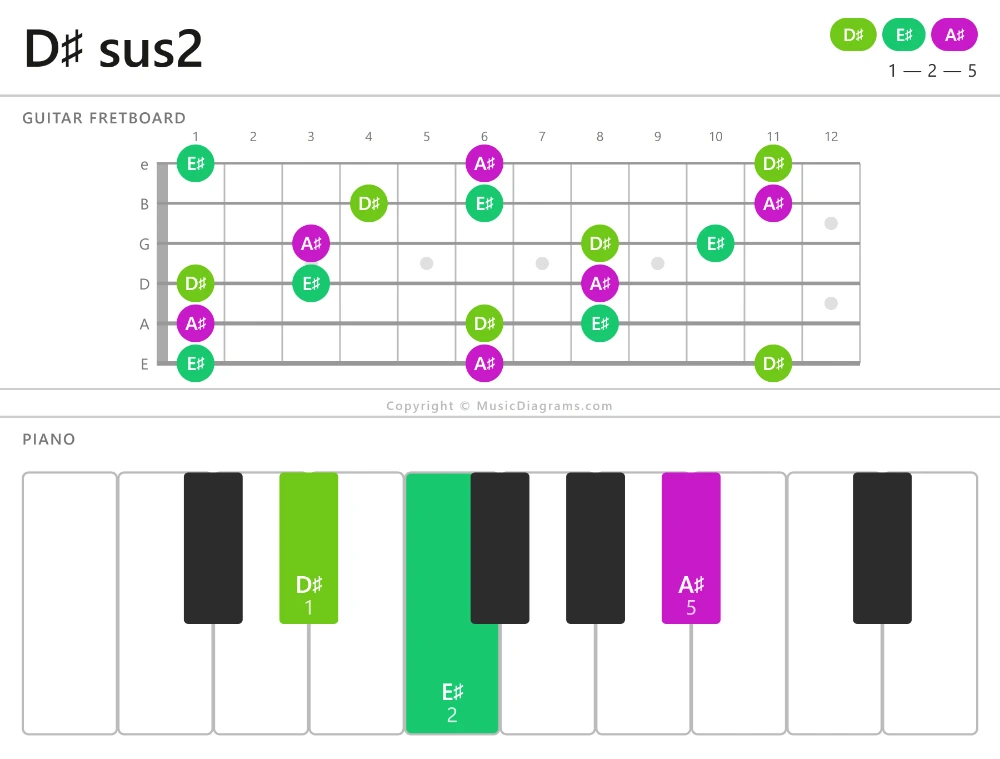
D-sharp suspended second is a Suspended chord built from the notes D♯, E♯, and A♯. Its root is D♯, and its interval number formula is 1–2–5, which gives you the interval names root, major second, and perfect fifth. Because it replaces the third with a second, this chord has an open, unresolved quality that makes it easy to recognize. It is also written as D♯ sus2, D♯ suspended 2nd, or D♯ suspended second. If you look at the widget above, you can see and hear how these three notes combine, and you can learn more about how they are spaced in chord intervals.
D♯ sus2 Alternate Names
- D♯ sus2
- D♯ suspended 2nd
- D♯ suspended second
D♯ sus2 Chord Notes
D♯ sus2 Chord Formula
D♯ sus2 Chord Notation
How To Use D♯ sus2 In Music
Often, D♯ sus2 sounds bright, airy, and slightly unfinished, which is exactly why composers and songwriters like to use it. Instead of sounding fully major or minor, it creates a gentle sense of motion that can resolve in different ways depending on the surrounding harmony. For example, it may move from D♯ sus2 to D♯ major for a clearer arrival, or appear in a progression like I–V–vi–IV when the tonic is colored with a suspended sound. In a key centered around D♯, you might hear I–IV–V, with I as D♯ sus2 for extra openness, and in other settings it can act as a passing color between stronger chords. If you are new to this idea, it may help to compare it with suspended chords more broadly.
D♯ sus2 Chord Inversions
Another useful idea is inversion, which means putting a note other than the root at the bottom. For D♯ sus2, root position is D♯–E♯–A♯, first inversion is E♯–A♯–D♯, and second inversion is A♯–D♯–E♯. Even though the notes stay the same, each inversion changes the balance of the chord, so one version may sound softer, more tense, or more stable than another. Musicians use inversions to make chord changes smoother, shape the bass line, and create different moods without changing the chord’s basic identity. You may also hear close voicings or wider note spacing used to make this suspended chord feel either tighter and more delicate or broader and more ringing.