The D♯ sus4 Chord Explained
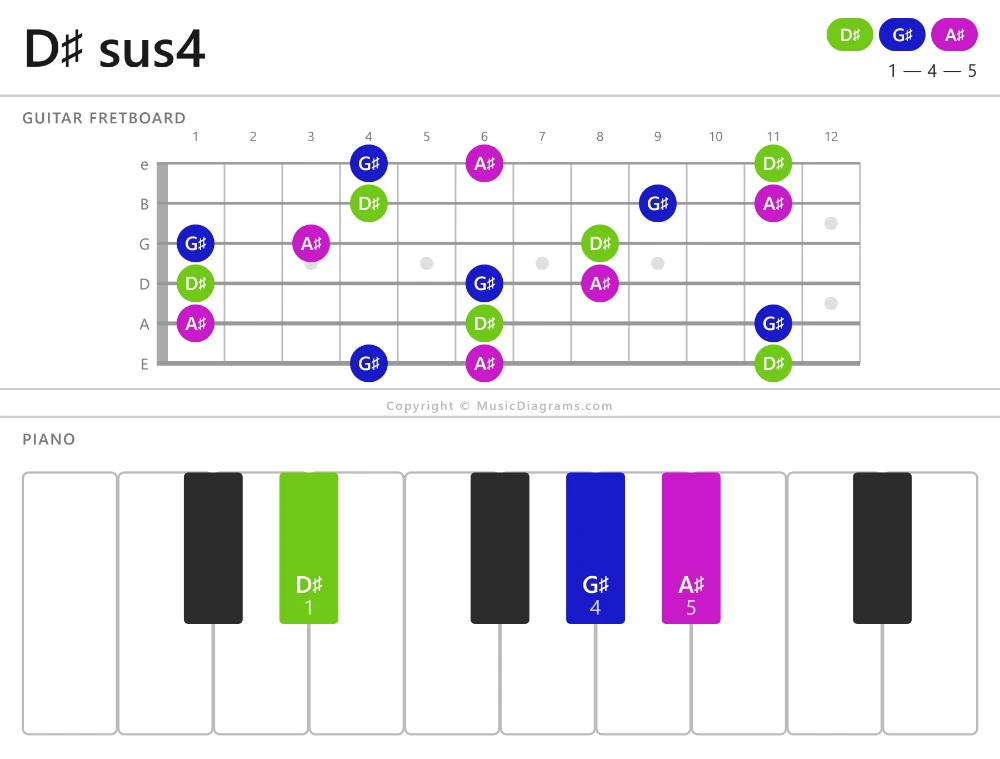
D-sharp suspended fourth is a Suspended chord built from the notes D♯, G♯, and A♯. Its root is D♯, and its interval number formula is 1-4-5, which gives you the interval names root, perfect fourth, and perfect fifth. Because the third is replaced by a fourth, this chord does not sound clearly major or minor, which gives it an open, unresolved quality. You may also see it written as D♯sus4, D♯ sus, or plain-text spelling such as D-sharp suspended fourth. If you are new to chords, the widget above can help you match these notes visually on piano and guitar, and you can learn more about chord intervals to see how the formula shapes its sound.
D♯ sus4 Alternate Names
- D♯sus4
- D♯ sus
- D-sharp suspended fourth
D♯ sus4 Chord Notes
D♯ sus4 Chord Formula
D♯ sus4 Chord Notation
How To Use D♯ sus4 In Music
Often, D♯sus4 sounds bright, steady, and slightly tense because the fourth wants to resolve, usually down to the third of a major chord. That makes it useful for creating anticipation in pop, rock, worship, and film music. For example, in the key of A♯ major, IVsus4 can move to IV, so D♯sus4 may resolve to D♯ major in a progression like I–IVsus4–IV–V. In a more flowing pattern, it might appear as ii–V–I sus4–I if the suspended sound is used right before resolution. The mood of the chord can feel more uplifting when surrounded by major chords, or more dramatic when placed next to tenser harmony. If you want a broader overview, this helps explain what is a chord and why suspended chords feel so distinctive.
D♯ sus4 Chord Inversions
Another useful idea is inversion, which means the chord keeps the same notes but starts on a different one in the bass. For D♯sus4 in root position, the notes are D♯-G♯-A♯. The first inversion is G♯-A♯-D♯, and the second inversion is A♯-D♯-G♯. These inversions still sound like the same basic chord, but they can feel smoother or more stable depending on which note is lowest. A first inversion can sound lighter and more floating, while a second inversion can feel more suspended and waiting to move. Players use inversions to connect chords more smoothly, reduce large jumps between bass notes, and shape the mood of a progression without changing the chord’s core identity.